TL;DR
A mother's journey through the shifting landscape of neurodiversity. As she fights for her son's right to be understood, she uncovers the hidden cost of her own history and the echoes of a family heritage rewritten by a new perspective.
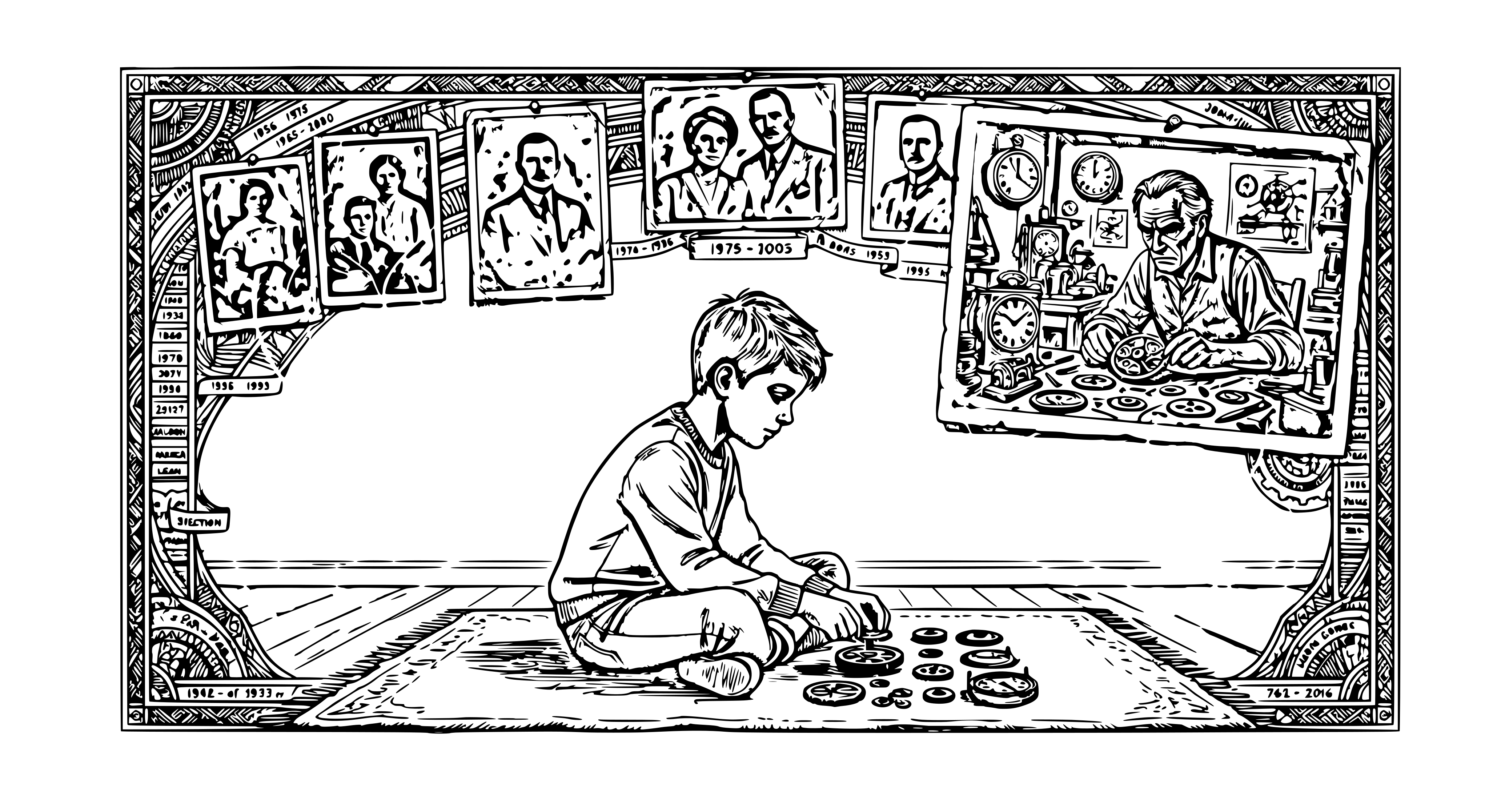
The Weight of the Mask
Lizzy always believed she was simply an expert at life. She was the one who could navigate a crowded office and manage a chaotic schedule, all while a quiet, internal static hummed beneath her skin. Since her teenage years, she had carried a heavy cloak of anxiety and a darkness that would settle over her without warning. Sometimes, in the middle of a loud supermarket or a tense meeting, she would feel herself drift—a strange dissociation where the world became a movie she was watching from a great distance. She learned early on to keep her face neutral, to never let the panic or the emptiness show in public, terrified that if she started crying, she might never stop.
"You were always so particular," her mother would say, the familiar sharpness in her voice a constant reminder. "Just like Jamie. You both have that thin skin. You have to learn to toughen up, or the world will eat you alive."
But as Lizzy watched Jamie stand frozen in the school hallway, his eyes glazed and his small hands balled into white-knuckled fists, she realised the toughening up had a price. It wasn't just a mood or a phase. It was a physical reality that she had been trying to outrun for decades.
The Two Ends of the Mirror
The demand for support is often described as a wave, but for Lizzy, it felt like a map being filled in. She was careful not to let her journey overshadow those with profound physical disabilities; she knew the world was already hard enough for those who required constant medical and physical care. Her battle was different. It was the struggle of the invisible.
At one end of this map were the stories her family whispered about—the distant relatives whose lives were clearly defined by their needs. But as she sat in meetings and read through descriptions of traits, she began to look toward the other end of the map. She thought of her Great-Grandfather, a man remembered as an unbearable disaster.
He was a man of impossible extremes. He would spend weeks obsessively focused on a single clock mechanism, neglecting food and sleep, only to erupt in a terrifying mood swing if someone moved a spoon out of place. He refused to go out at the last minute, leaving the family stranded on doorsteps because the "air felt wrong." Yet, while he demanded perfection in his interests, he hoarded everything else. His home became a labyrinth of newspapers and broken tools, a living disaster that made his life, and everyone else's, an exhausting ordeal. For generations, he was just "wicked" or "mad." Now, Lizzy saw the same live wire that hummed inside Jamie, just expressed in an era that lacked the tools to understand him.
The Hidden Cost of Coping
The difficulty in this journey is that many of these traits are things everyone feels to an extent. Everyone finds a loud restaurant annoying; everyone likes a routine. But for Jamie and Lizzy, it isn't an annoyance. It's an internal overload.
It is the difference between a pebble in your shoe and walking on broken glass. The mask is the immense, invisible effort required to pretend the glass isn't there. Lizzy had spent thirty years perfecting that mask, and the cost was a chronic, heavy fatigue. She saw other children at the school gates doing the same. There was Chloe, who was so polite in class that her teacher didn't believe she struggled. Yet, Chloe would reach the car and sob for an hour because the effort of being normal had shattered her. It wasn't an excuse for bad behaviour; it was the inevitable collapse of a child who had run out of air.
The Key
The struggle to find a name for this isn't about looking for a label to hide behind. It is about finding a manual for a brain that didn't come with one. Lizzy spent months navigating a world of paperwork and professional visits, realising that the people who provide these life-changing insights, the clinicians and the psychologists, are working within a system that was never designed for this many people to suddenly wake up and say, "I see myself now."
The system was built for the ends of the spectrum that were visible and easy to categorise. It wasn't built for the silent struggle, the high-functioning anxiety, or the child who masks their pain until they break.
A New Understanding
The turning point didn't come from a signature on a form, but from a quiet moment on a Sunday afternoon. Jamie was sitting on the rug, lining up his toys with a focused, peaceful intensity. Lizzy sat beside him and, for the first time, didn't try to distract him or make him play properly. She simply watched. "The clock is ticking too loud, Mum," he said, not looking up.
In the past, Lizzy would have told him to ignore it. She would have told him to be tough, the way she had tried to be tough through her own years of dissociation and fear. Instead, she stood up, took the clock off the wall, and put it in the kitchen.
"I know," she said. "I can hear it too."
The surge in people seeking a name for their experience isn't a disaster; it's an epiphany. It is a generation of parents realising that the wicked relatives and the sensitive children were all part of the same story. Lizzy looked at her son and realised he wasn't a problem to be fixed; he was a pioneer of a different kind of brilliance. After all, her unbearable Great-Grandfather had been the lead engineer on a project that changed the industry—his obsessiveness was the very thing that allowed him to see solutions others missed. Jamie didn't have a broken brain; he had a specialist one, and now that they had the right map, they could finally stop surviving the storm and start learning how to fly within it.
This story is for educational and illustrative purposes only. It does not constitute professional advice.