TL;DR
Is Alternative Provision a dead end or a lifeline? Follow Arlo's journey from a failing mainstream school to a specialised setting that finally understood his sensory needs. A story of hope, safety, and the bridge back to learning.
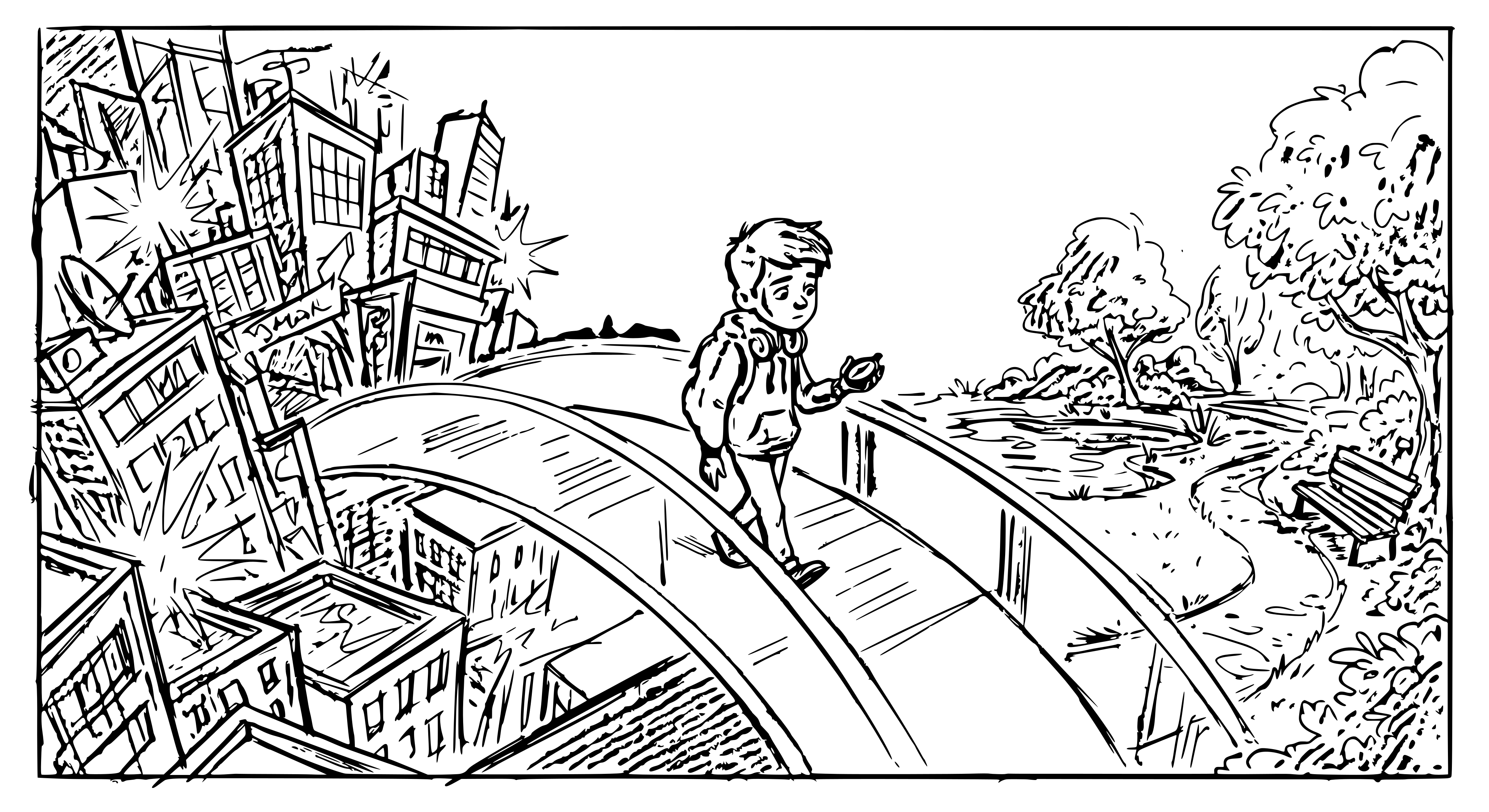
The Silent Support
The 7:00 AM alarm didn't just signal the start of a day; for Mum Maggie, it was the opening bell of a long-running tragedy. For months, she had lived with a hollow feeling in her chest, a quiet certainty that the school had simply run out of patience. She assumed that by suggesting Alternative Provision, they were handing Arlo a one-way ticket out of their sight. She didn't realise that behind the scenes, the school was making a difficult, expensive choice to keep him. Because Arlo remained on the school's roll, the mainstream setting was still legally and financially responsible for him. They weren't just passing him off; they were investing in external specialists to do the intensive, foundational work they lacked the capacity to manage in a room of thirty.
The 12-Week Roadmap
Every week Arlo spent at the AP, the school paid a significant fee from their own budget—a clear, cold admission that the current environment was failing him. Initially, it felt like putting a price tag on her son's presence, but as the plan arrived in her inbox, Maggie saw it differently. The school wasn't paying to lose him; they were paying for a re-entry manual. The programme described by the mentors wasn't a wait-and-see period, but a 12-week countdown toward independence. For the first time in years, the family had a map instead of a list of complaints.
In the first four weeks, the focus was entirely on decompression. Arlo stayed at the AP site, away from the bells and the crowds, where the work was subtle and quiet. The goal wasn't to force algebra; it was to teach Arlo to notice the physical tells of his own stress before they escalated into a crisis.
Learning the Language of the Body
"I think my jaw gets tight because I'm trying not to shout," Arlo admitted one afternoon while sitting in the quiet garden room. His mentor, Marc, didn't make a big deal of it. He just nodded and said, "That makes sense. Once you feel that tightness starting, what do you think is the first thing we can do to give you some space?" This was the beginning of the advocacy toolkit phase, where Arlo practised the words he needed to survive a mainstream classroom.
However, this wasn't a "get out of jail free" card. Marc was firm: "If you use the library to escape a difficult maths problem rather than a sensory overload, the system fails. We're giving you the remote control, but you have to show us you can use it responsibly." Arlo was held accountable through a daily log; every time he used his hallway pass or noise-cancelling headphones, he had to record the trigger and the outcome. If he moved to the library, he was still expected to complete the work, just in a space where he could actually think.
Peace of Mind
Maggie worried about the safety of these smaller hubs, but she learned that even smaller, specialised centres are kept on a tight leash. The mainstream school has a legal duty to ensure Arlo is safe, which triggers regular quality assurance visits to check safeguarding, staff ratios, and the physical safety of the environment. In mainstream school, progress had been a series of letters and percentages on a spreadsheet that never seemed to move. In AP, the monitoring looked at engagement and regulation. The mentors tracked how many times Arlo identified a trigger before it led to an outburst and his ability to use his timeout card independently. This was real-life progress. It was the most important information Maggie had ever read because it showed that Arlo was moving from being a victim of his environment to a master of it.
The Slow-Drip Return
The final phase was a slow-drip return. It started with one hour a week in the Art block—Arlo's happy place. A mentor from the AP accompanied him, not to watch his work, but to monitor his movements. They were building a history of success, one hour at a time. By week twelve, the "Arlo Solution" began to ripple outward. The AP mentors spent time with his mainstream teachers, pointing out that if a humming light was hurting Arlo's head, it was likely distracting the other twenty-nine students, too. The school began to adapt. They realised that by allowing Arlo to use his noise-cancelling headphones or his hallway pass, the atmosphere in the classroom actually became calmer for everyone. When the most sensitive student is supported, the whole room settles.
A New Morning
On the final Monday of the programme, the 7:00 AM alarm went off. Arlo didn't jump out of bed with a smile, but he didn't hide under the duvet, either. He reached for his bag, checked for his navigation tools, and stood up. "You got everything?" Mum asked, her voice hitching slightly as she watched him by the front door. Arlo gripped the strap of his bag and gave a small, sharp nod. "I've got the card," he said quietly. "If it gets too much, I know where to go." He knew he couldn't change the school's volume, but for the first time, he knew he had the remote control in his own pocket. The 7:00 AM Battle was over.
This story is for educational and illustrative purposes only. It does not constitute professional advice.