TL;DR
In a world that treats heavy textbooks as the only real way to learn, Sam's brain just couldn't find the signal. This is a story about the moment Sam stopped trying to force his eyes to follow blurry lines of text and started listening to the logic of code instead—proving that when we stop trying to learn the standard way, we finally give our brilliance the space to breathe.
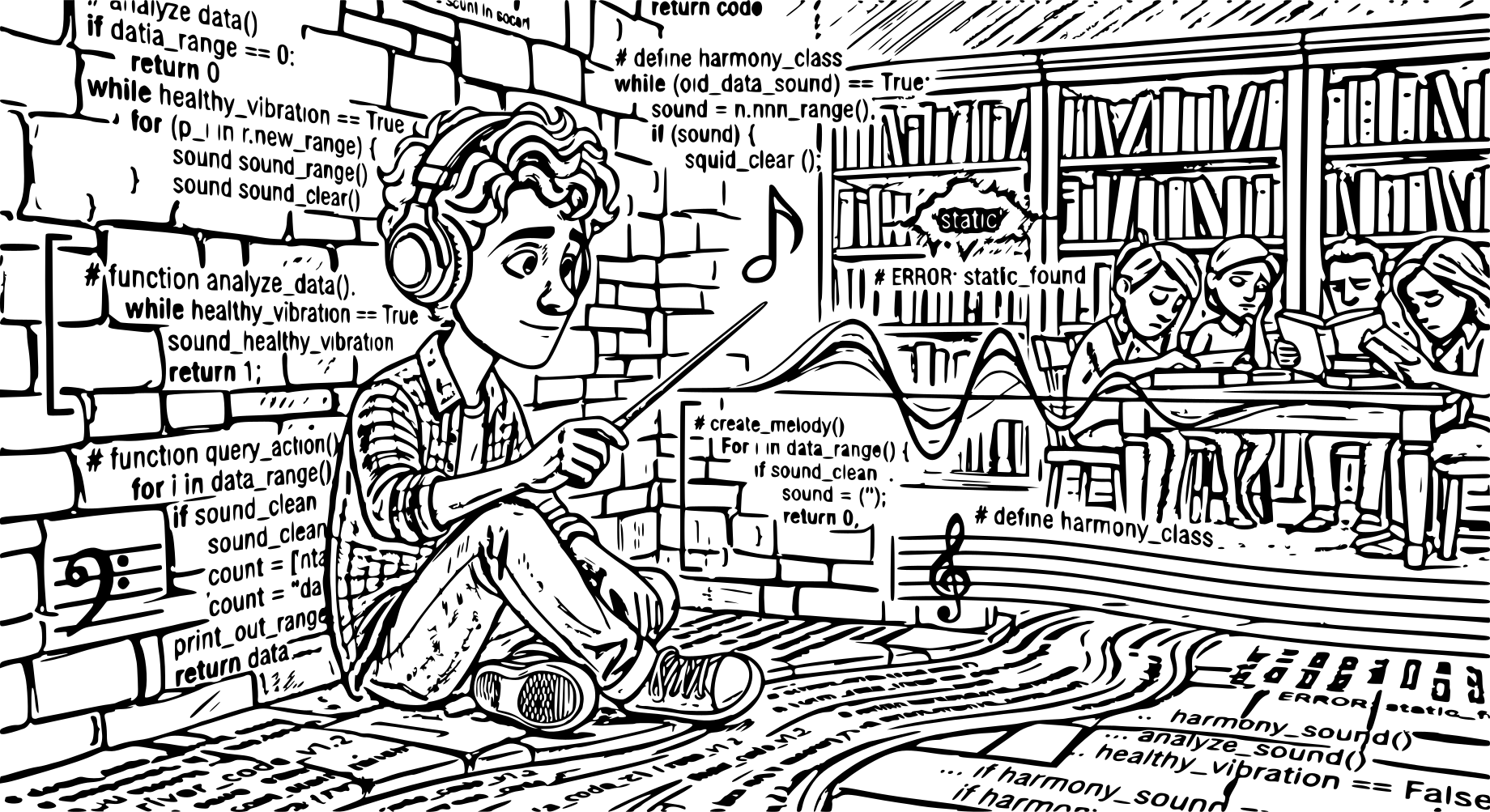
The Graveyard of Books
The university library was a temple of silence, but for Sam, it felt like a graveyard. Row after row of students sat hunched over textbooks, their highlighters scratching across paper like tiny, dry insects. Sam tried to join them, but after ten minutes, the black ink began to swim. The lines of text didn't sit still; they drifted and blurred—a slow, weak signal trying to reach a high-speed brain.
To his lecturers, Sam was just another student with a short attention span. In the lecture hall, he felt like he was drowning in words while everyone else was swimming. Numbers and long lists of facts leaked out of his memory like water through a sieve.
But when Sam looked at a screen of code, he didn't see a wall of text. He saw a living, breathing architecture. He just needed a way to step inside it.
The Auditory Breakthrough
Sam's breakthrough didn't happen during a presentation; it happened in his bedroom with a pair of noise-cancelling headphones. He had discovered a set of plugins designed for "sonification"—tools that translated the structure of his code into a landscape of sound.
It wasn't that the computer was reading the words out loud. Instead, the software mapped the logic to a scale of notes. A steady stream of data became a rhythmic pulse; a moment where the program had to make a choice became a soaring violin string.
This was his secret weapon. While his classmates squinted at screens trying to spot a missing bracket, Sam just listened. This kind of audio debugging made the invisible visible. If he made a mistake—a tiny typo or a broken link—the harmony would shatter. A mistake in the logic sounded like a jarring, sour note in the middle of a song. A clean, perfect loop sounded like a beautiful, repeating melody.
He wasn't reading the code anymore; he was feeling the rhythm of it. By turning his work into a symphony, Sam could hear the health of his program. If the music was smooth, the logic was flawless. He mastered in three weeks what usually took an entire semester in the lecture hall.
He didn't need the information to be easier; he just needed it to be louder. While the library demanded he use only his eyes, his brain was hungry for the full volume of the world.
The Collision
The final-year project threw Sam into a team with two others. Usually, this was his nightmare—the endless shared documents and the constant arguing over wording.
The team was a total mix of styles. There was Maya, who kept a rigid, flawless timeline. There was David, who constantly sketched 3D models on the whiteboard with manic energy. And there was Sam, sitting in the corner with his headphones on, "listening" to the heartbeat of their app.
At first, tensions were high. “We're all pulling in different directions," Maya sighed, looking at David's messy drawings and Sam's musical code.
The Masterpiece
"That's the point," David said, stepping back from the whiteboard, his hands covered in marker. "If we all thought like Maya, the project would be perfectly organised but we'd have no product. If we all thought like me, we'd have a model but no logic to run it. And if we all thought like Sam..."
"We'd have a very cool-sounding app that nobody knew how to use," Sam finished, grinning.
They stopped trying to force each other to work the "standard" way. They realised that their different brains weren't a hurdle to get over—they were the engine that made the project move.
When they stood before the judging panel back in the lecture hall, they didn't just hand over a dry paper. They created an experience. They had a physical prototype to touch, logical charts to follow, and Sam's musical code to hear.
The lecturers were silent. Not just because the technology was smart, but because for the first time, everyone in the room could truly see how it worked, no matter how their own brains were wired.
A New Kind of Power
As Sam walked out of the hall, he looked back at the library through the glass windows. For centuries, that building had treated every mind like a part in a factory. If a part didn't fit the machine, it was called defective.
But the world wasn't a factory anymore.
Sam pulled out his phone and sent a quick message to the group. He didn't apologise for his messy handwriting or the things he'd forgotten. For the first time, the noisy world felt exactly like the place he was meant to be. He wasn't struggling to keep up anymore. He was finally playing his own music, and for once, the world was listening.
This story is for educational and illustrative purposes only. It does not constitute professional advice.