TL;DR
Discover the power of the spiky profile in The Idling Engine. Follow Zach's journey as he moves beyond labels, using assistive technology and a neuro-inclusive approach to turn classroom challenges into brilliant strengths. A must-read for parents and educators navigating neurodiversity and learning differences.
The Idling Engine
Parents' evening always felt like a collision of two different worlds. Mum Susie and Dad Tom sat on tiny plastic chairs facing Mrs Gable across a desk littered with colourful alphabet charts that, to Zach, looked like nothing more than meaningless scratches on a page.
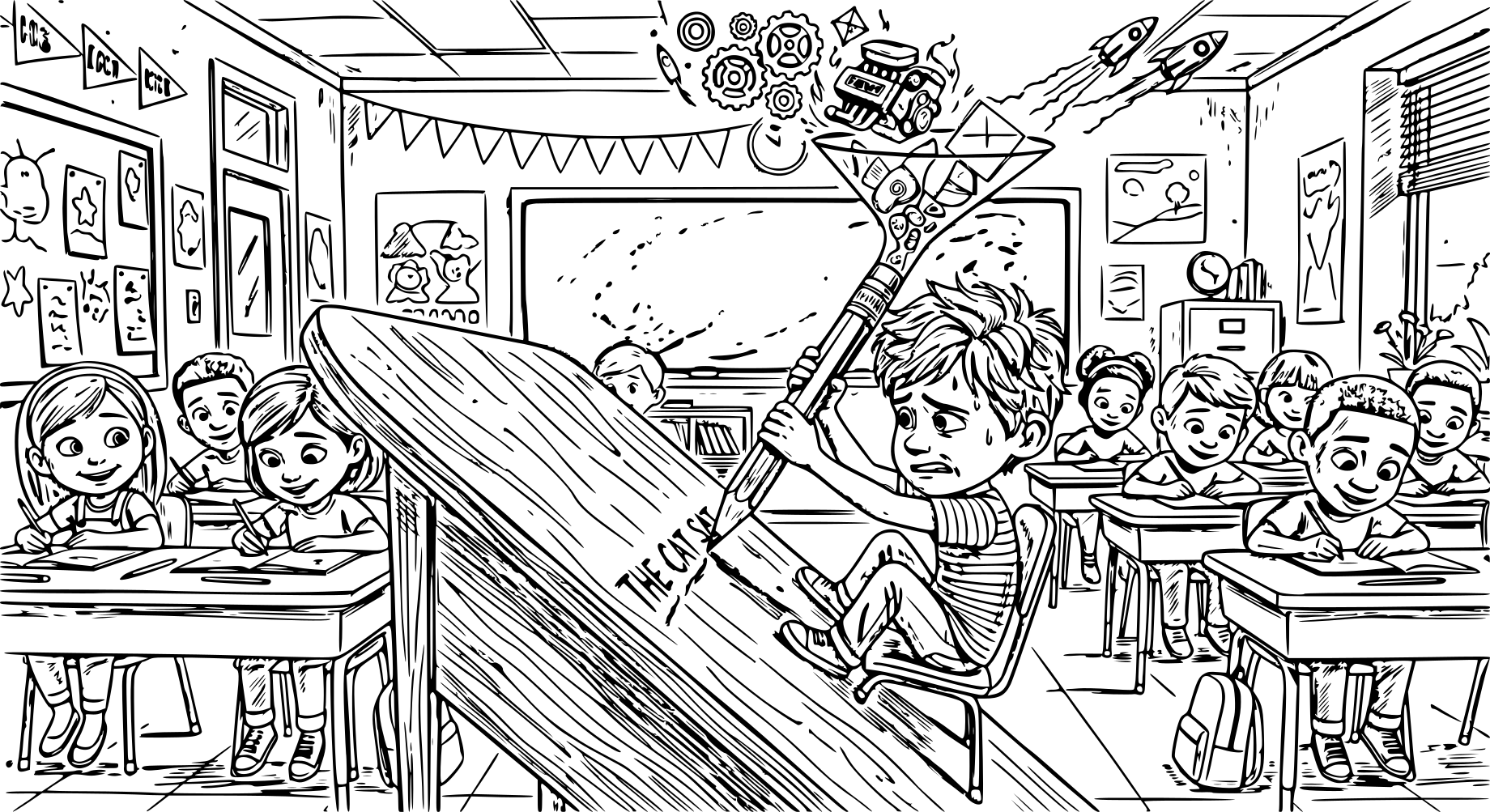
Inside the classroom, Mrs Gable flicked through a battered exercise book. She simply pointed to a page where a single sentence—The cat sat on the mat—was surrounded by a chaotic blizzard of graphite smudges and a hole where the paper had been rubbed through until it gave up.
"He spent twenty minutes explaining exactly how the school's boiler and radiators work to the rest of the class. He can tell you everything in detail—he's better than the site manager. But when it comes to the exercise book..." She sighed, tapping the torn page. "We're losing all that intelligence somewhere between his head and the paper."
Zach was at home, a coil of restless energy. One leg was tucked under him, the other was drumming a frantic rhythm against the coffee table. He was staring at a pile of discarded kitchen gadgets and a box of old gears. He wasn't looking at them as junk; his eyes moved with predatory speed, seeing exactly how the teeth of a whisk could drive the axle of a toy car.
The Power Curve
A month later, the kitchen table was covered in charts and graphs—a technical map of Zach's mind. Susie traced her finger along a line on a graph that looked like the teeth of a saw.
"Look at this peak," she whispered. "Visual-spatial reasoning: 98th percentile."
"And look at the valley," Tom replied, pointing to a sharp drop on the far right of the chart. "Processing speed and fine motor coordination: 8th percentile."
The specialist had called it a "Spiky Profile." To the world, the spikes looked like brilliance and the valleys looked like defiance. To Zach, the valleys were just places where his thoughts got stuck in the mud. He hadn't known there was a name for the itch in his brain that made the letters jump, or the electricity that made a quiet classroom feel like a hive of bees.
Plugging In
By the following Tuesday, the scratchy school pens were gone. Tom handed Zach a tablet in a rugged, industrial case.
"We're trying something," Dad told him.
Zach looked at the screen and started to talk. He explained how a car engine breathes—how the pistons move up and down to turn the wheels. On the screen, his spoken words transformed instantly into clear, black text. Zach stopped. He touched the glass, watching the sentences sit there, perfect and legible.
"It's catching up to me," Zach whispered.
The Racetrack
In the corner of the classroom, the normal desk was gone too. In its place was a stool that wobbled and tipped, allowing Zach to rock while he worked. To an outsider, he looked restless. To Zach, the movement was the only thing keeping his engine from overheating.
The end-of-term "Future Cities" project was the true test. The classroom was a mess of cardboard boxes and leaking glue sticks. Zach was in the middle of it, completely locked in. While the other children were still struggling to cut straight lines, Zach was using his tablet to look up how real skyscraper foundations worked. He'd found a way to wire a basic battery circuit through his cardboard buildings, making the windows glow with tiny LEDs. His fingers moved across the tablet and the wires with a steady, easy confidence that vanished the moment he was handed a pencil.
The Final Presentation
On the final day, the school hall was packed. A visiting local architect stopped at Zach's display—a complex, multi-layered marvel of recycled plastic and glowing LEDs.
"That's a lot of weight for those tiny supports," the woman remarked, leaning in to look at the base.
"How did you know it wouldn't just topple over?"
Zach didn't look down or shuffle his feet. "It kept wanting to fall over," he said, pointing at some old wooden skewers he'd taped across the corners. "The top was too heavy, so I made the bottom part bigger. Like a spaceship. Now the weight stays in the middle and it doesn't bend anymore."
Mum and Dad watched from the back. They didn't see a boy with a 'disorder.' They saw a child who had finally found his own frequency.
Mrs. Gable walked over, her expression unreadable. She looked at the model, then at the tablet resting on Zach's lap. She turned to Mum and Dad with a beaming smile.
This story is for educational and illustrative purposes only. It does not constitute professional advice.