TL;DR
Susie's brain is like a race car stuck in a 20 MPH zone. Outside the hospital, she's the person who loses her keys while they're in her hand and forgets every deadline she's ever been given. This is a story about the Focus Paradox—the moment Susie stops being the scattered one and becomes the calmest person in the room, proving that some minds don't need less noise to work; they need the world to turn the volume up.
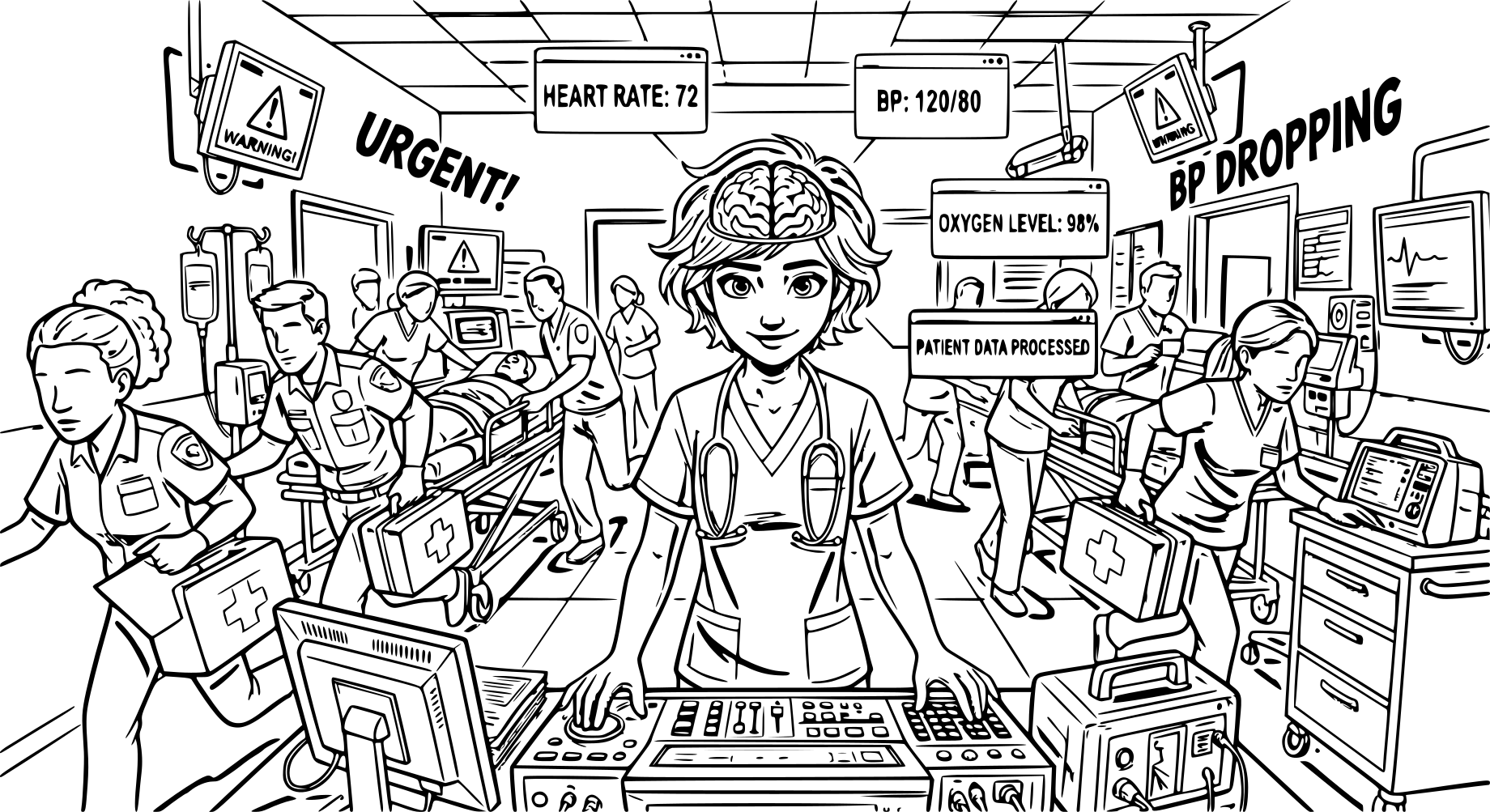
The Scatty One
The hospital's fluorescent lights hummed at a frequency that usually made Susie want to crawl out of her own skin. But as she pushed through the double doors of the Emergency Department, that feeling vanished. The air was thick with the smell of antiseptic and the frantic pulse of monitors, and for the first time all day, Susie's mind stopped vibrating.
Outside of these walls, Susie's life was a graveyard of half-finished projects. Her kitchen was full of abandoned hobbies; her car was overdue for a service she'd forgotten to book three times. To her family, she was "the scatty one." To the world, she was someone who simply couldn't keep her head on straight.
But inside the ER, the labels didn't just fall away. They flipped.
Trauma Room Zen
At 3:00 AM, the red "Trauma Alert" light began to pulse. A multi-car crash was ten minutes away.
For most people, this is the moment the heart rate spikes and the world turns into a blur. For Susie, it was the moment the world finally slowed down to her speed. Her brain, which usually felt like a television with the remote stuck on channel hopping, suddenly locked onto a single, high-definition broadcast.
In a quiet office, Susie's brain starved for excitement, hunting for distractions just to stay awake. But in a crisis, the chaos provided exactly the amount of fuel her mind needed to reach top gear. She wasn't calm despite the noise; she was calm because of it.
The Conductor
The doors burst open. "Male, 30s, chest injury, blood pressure dropping!"
The room exploded. Nurses reached for IV lines; equipment was wheeled in; a student doctor stood frozen, overwhelmed by the sheer number of moving parts.
Susie moved into the space like a conductor. Her brain, which struggled to follow a simple grocery list, was now effortlessly tracking twelve things at once: the rhythm of the breathing machine, the colour of the patient's skin, the frantic tone of the paramedic's voice, and the subtle shift in the heart monitor's beep.
"He can't breathe," Susie said. Her voice was steady, almost melodic. "I need a needle, now. Call X-ray. Tell them we're not waiting. Move."
She wasn't losing focus; she was processing a high-speed stream of information faster than anyone else in the room. What the world called "distractibility" was actually her greatest weapon: she could see every tiny change in the room before it became a disaster.
A Mind in Motion
Two hours later, the patient was stable and the adrenaline in the room began to fade, leaving the rest of the team looking shattered. Susie, however, felt a sense of quiet clarity.
She sat in the breakroom, staring at a lukewarm cup of tea. She thought about her cousin, who worked in a quiet library and loved the silence. If Susie worked there, she'd be a failure—unable to focus, prone to mistakes, and perpetually frustrated. In that world, her brain was a broken tool.
But here, the tool was perfect.
"Nice save, Susie," a senior doctor said, leaning against the doorframe. "You didn't even blink. I don't know how you keep it together when everything is falling apart."
Susie just smiled. She didn't try to explain that her brain finally felt still in the middle of a storm. She didn't mention that for her, the real struggle wasn't saving a life in the dark—it was remembering to live her own in the quiet.
A Specialist in the Storm
Susie realised she hadn't been failing at life; she had simply been living at the wrong speed for the world around her. She didn't need to change who she was; she just needed a life that moved as fast as she did. She'd still forget to buy milk on the way home, and she'd still lose her phone twice before she even reached the front door. But for twelve hours a shift, she was the most reliable person in the building.
Walking away from the hospital doors, Susie zipped up her coat and took a breath of the crisp air. The cluttered, noisy feeling of the day before was gone, replaced by a resonant sense of purpose. She had stopped trying to survive the quiet and started leaning into the chaos.
She wasn't a puzzle to be solved. She was the solution. Her brain hadn't led her here by accident; it had steered her towards a world that moved at her speed, a place where her lightning-fast thoughts were an asset rather than a distraction. Shift after shift, the heavy slog of the life chores faded, because here, she was doing exactly what she was built to do.
This story is for educational and illustrative purposes only. It does not constitute professional advice.