TL;DR
Stop viewing dyslexia as a deficit. The Weight of the Word reveals how system-seeking minds excel in spatial reasoning and strategic oversight. Learn how David switched mental paralysis for assistive tech and 3D visualisation, proving that success is about brain architecture, not just reading speed.
The Weight of the Word
The site office was a chorus of shouting men and the rhythmic thud of a pile driver, but for David, the real noise was the stack of health and safety manuals sitting on his desk. At fifty-two, David was the site manager for one of the largest residential builds in the city, yet the sight of a twelve-point font still made his stomach churn.
He picked up a highlighter, trying to anchor the words to the page. They drifted. The letters swapped places like bored children in a classroom. "Dyslexic" was a word he'd heard in passing, but in his day, the label was simpler: thick. He'd spent thirty years overcompensating, arriving an hour early to memorise blueprints so he wouldn't have to be seen struggling to read them in front of the lads.
He could build a skyscraper from memory, but he felt buried under the weight of words.
The Architecture of the Mind
The project was behind schedule. The junior engineers were huddled around a laptop, scrolling through 2D CAD drawings, arguing about millimetres.
"It doesn't fit," one said, pointing at the screen. "The cross-section says we have to reroute through the stairwell, but that breaks fire regs."
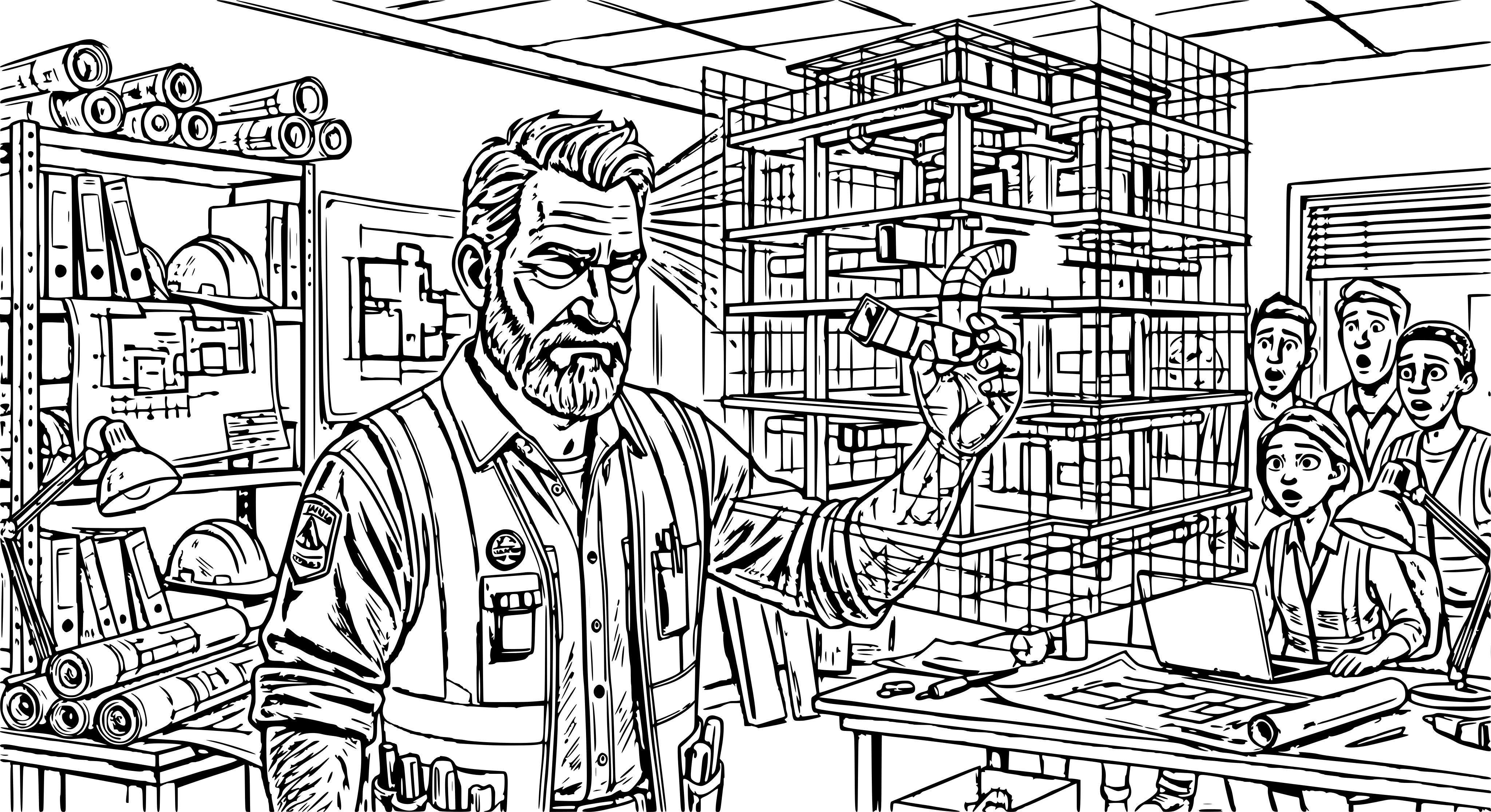
David stood behind them. He wasn't looking at the numbers or the labels. He closed his eyes. In his mind, the 2D lines on the screen folded upwards. The drawing didn't stay flat on the screen; it unfolded in his mind. He was navigating the empty corridors before they were even built, shifting the layout in his head like a puzzle that only he could see.
"Don't touch the stairwell," David said. "Tilt the intake forty-five degrees and tuck it into the empty void behind the lift shaft. You can pick up the extra room by dropping the corridor ceiling just five centimeters."
The engineers went quiet. They tapped at their keyboards, re-modelling the suggestion. Thirty seconds later, the red "clash" warning on the screen turned green.
The Realignment
That night, David didn't reach for a book. He reached for his phone and watched a video on M-Strengths—the specific wiring often found in dyslexic minds.
He learned that while his brain struggled to follow a straight line—whether a sentence or a list—it was built to see the whole map at once. He wasn't 'thick'; he was a high-speed processor for space and systems. He could see how a single screw turned on day one would ripple out to affect the entire build on day two hundred.
The realisation hit him like a swinging crane. He had spent his life trying to fix his reading, which was like trying to park an artic lorry in a bicycle rack. He was ignoring his greatest asset because it didn't look like the kind of intelligence that fits between two margins.
Beyond the Site Plan
David binned the paperwork. He bought a tablet and told his sub-contractors that he didn't want to see another report unless it was a voice note or a photo. He stopped squinting at tiny text on a screen and let a program read his emails while he walked the site.
The change was immediate. It was like the handbrake had finally been released.
A month later, the project director visited the site. "I was worried about you moving into management, David. I thought the paperwork might... get on top of you."
David gave the tablet on his arm a knock. "No more chasing paper. The drawings were a proper disaster this morning, but I caught it before the lads even started pouring.”
As David stepped back onto the grid of rebar, the old weight of his failed O-Levels was gone. He didn't need to read the site; he could feel it. While the engineers were still buried in their charts, David could see exactly where every bolt and beam had to go. He'd stopped trying to follow their map and started trusting his own eyes.
This story is for educational and illustrative purposes only. It does not constitute professional advice.