TL;DR
Is your environment draining your brain? The Soup of Noise explores sensory overload in the classroom and the quiet revolution that unlocked student focus. Learn how reducing visual clutter and managing sensory thresholds creates a neuro-inclusive space where everyone can breathe and learn.
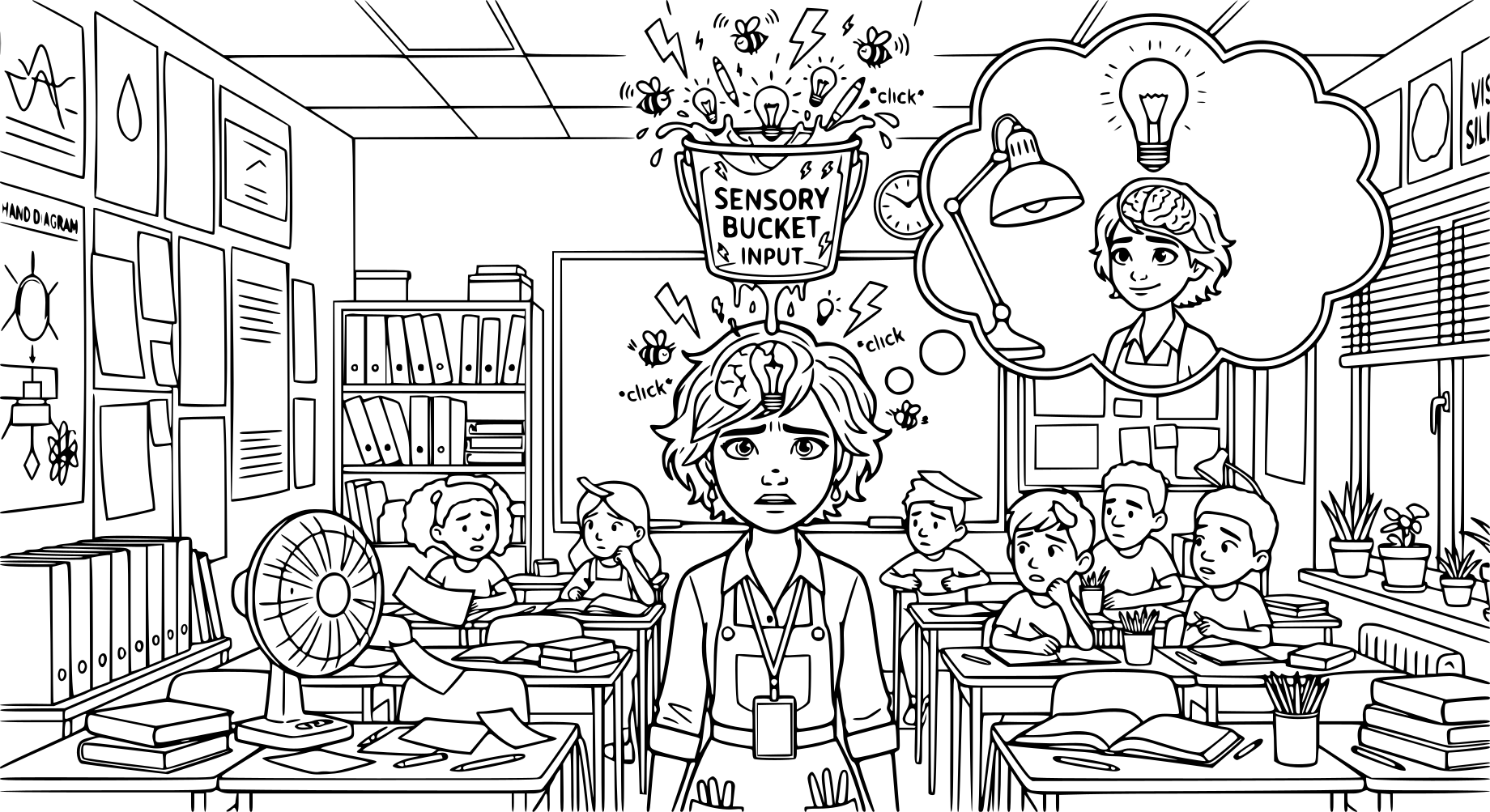
The Soup of Noise
The staff room was a thick soup of noise, an exhausting scramble of voices and machinery that left no room for a quiet thought. The industrial-grade toaster was clanking, three teachers were debating the new phonics curriculum, and a radio in the corner was playing a tinny pop song from the 2010s.
Chloe sat in the corner, her fingers pressed hard against her temples. To anyone else, she was just a teacher stealing a moment of peace before the bell. To Chloe, the room was a physical weight, pulsing with a restless energy she couldn't filter out. She simply lacked the internal volume knob most people use to dim the world.
The Sensory Bucket
Chloe walked into her Year 5 classroom. It was standard practice to have the walls covered in bright, primary-coloured posters, dangling mobiles from the ceiling, and a Busy Bees board that tracked every student's progress in neon ink.
"Right, everyone," Chloe said, but her voice felt thin. The overhead fluorescent light was flickering—a tiny, rhythmic pulse that felt like a needle tapping on her forehead. One of her students, Zach, was clicking his pen. Another was kicking the metal leg of a desk.
Chloe felt the last of her patience slipping away. When the mind is stretched too thin, the ability to think clearly evaporates, replaced by a raw, instinctive need to escape the noise. She wasn't angry with the children; she had simply reached the edge of what she could endure.
"I... I need everyone to stop," she said, sharper than she intended. The room went quiet, but the flickering light remained. The invisible hum of the school was winning.
The Great Uncluttering
The turning point came when Chloe visited a colleague's classroom in a different borough. It was stark. The walls were a soft, muted sage green. There were no dangling mobiles. The posters were grouped in one corner, and the rest of the wall space was visual silence.
"It's not boring," her colleague explained. "It just gives the brain a chance to breathe."
Chloe realised she had been teaching in a sensory storm. She went back to her room on a Saturday morning. She stripped the neon posters. She replaced the flickering fluorescent tubes with warm, dimmable lamps. She put felt pads on the bottom of every chair leg.
She wasn't just doing it for herself. She thought of Zach, who spent half his day staring at the dangling mobiles instead of his work. She thought of Maya, who always seemed to have a headache by lunchtime.
The Sound of Focus
On Monday, the children walked in and stopped.
"Is it broken?" Zach asked, looking at the dimmed lights and the bare walls.
"No," Chloe smiled. "It's quiet."
The change was instantaneous. Without the clutter competing for their attention or the constant hum of the background, the classroom settled. The children didn't need to shout to be heard, because they were no longer fighting against the room itself.
Chloe realised that everyone is wired to a different internal thermostat. Some people are thrill-chasers, needing a surge of music and motion to spark their brains into gear. Others, like her, are peace-seekers, who do their best work when the world is dialed down. The great mistake was assuming that the typical classroom—a chaotic mix of neon colors and constant noise—was a neutral starting line. It wasn't. It was an invisible tax on everyone's energy.
The Superpower of Stillness
By the end of the term, Chloe's Quiet Revolution had become the talk of the school. Her students were calmer, their reading scores had begun to climb, and for the first time in years, Chloe didn't go home and collapse into a dark room for two hours.
She sat at her desk after the final bell. The school was still, but it wasn't a dead silence—it was a productive one. She looked at the soft green walls and felt her brain finally exhale.
She hadn't changed who she was. She hadn't cured her sensitivity. She had simply realised that her sensitivity was a compass. If a room was too loud for her, it was likely too loud for the children to learn deeply. By honouring her own internal rhythm, she had given twenty-five other people the gift of a clear mind.
She reached out and turned off the last lamp, walking out of a room that finally felt as calm as the thoughts she was now free to think.
This story is for educational and illustrative purposes only. It does not constitute professional advice.