TL;DR
Staring at a £300 trillion debt clock, data analyst Ria realises she's trapped in a rigged game where inflation erases the value of her hard work. After a chance encounter reveals that currency is just a shifting digital promise, Ria decides to stop chasing devaluing cash. Instead, she shifts her focus to building real-world value.
The Doom-Scroll of Doom
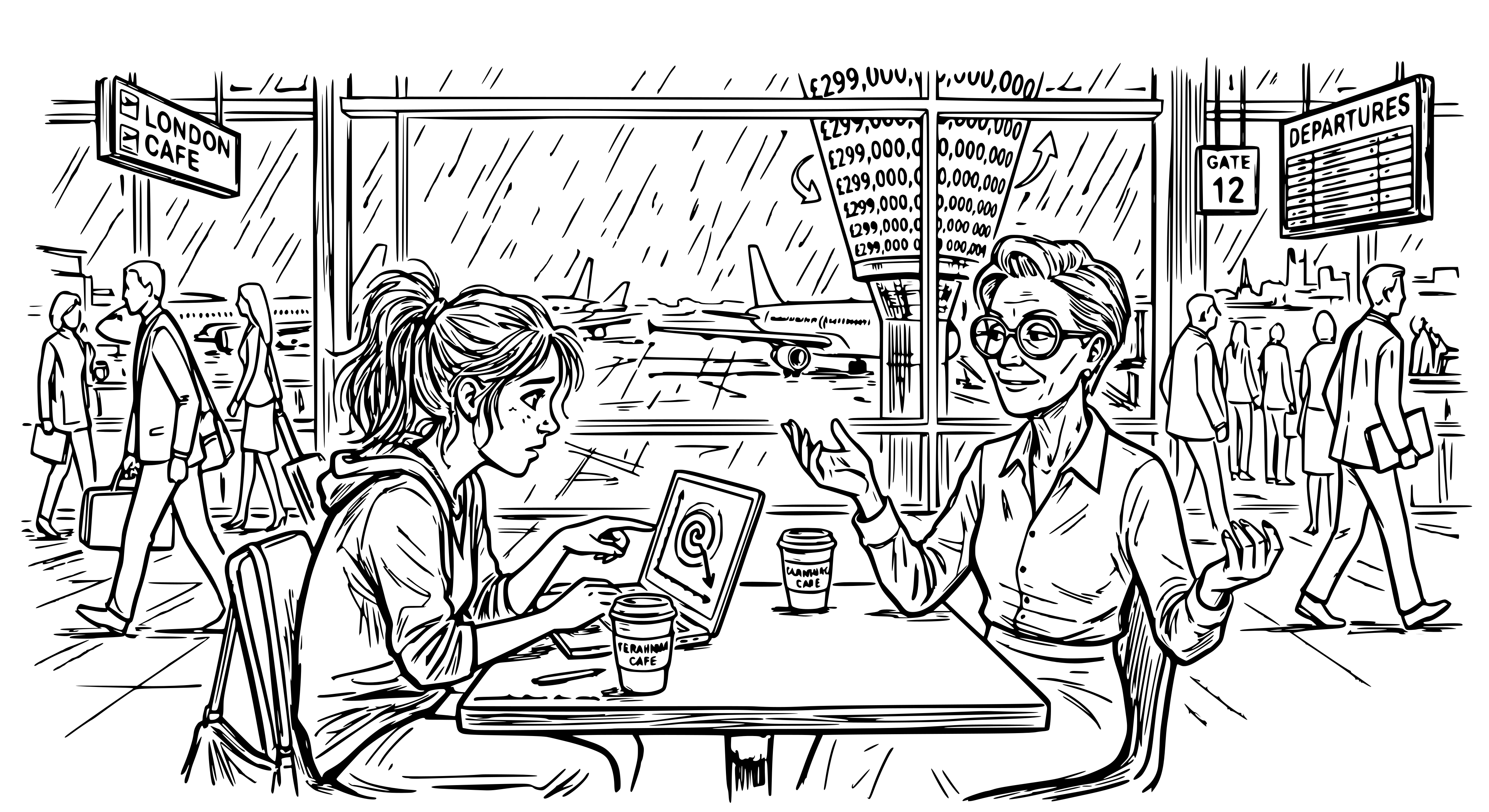
Ria sat in the airport terminal, nursing a lukewarm latte that cost more than her first hourly wage—apparently hand-milked from a golden alpine cow. On her screen, she wasn't looking at memes; she was staring at a global debt clock.
The numbers were spinning so fast they looked like a glitch in a video game. Trillions. Quadrillions. It was a scoreboard for a game Ria hadn't asked to play, yet somehow she was losing. At twenty-four, with a degree in data analytics, the only trend she saw was a downward spiral.
"Great," she muttered, scrolling past a headline about the inevitable collapse of everything. "I was born into a world that's already been spent. I'm just a walking, talking line of credit for a bank that doesn't even know I exist."
Every hour she worked felt like a tiny drop of water thrown at a forest fire of national debt.
The Woman Who Stopped Counting
"You know, staring at that is about as useful as trying to teach a cat how to do your taxes," a voice drifted across the table.
Ria looked up. Across from her sat Vesper, a woman who looked entirely too relaxed for someone surrounded by airport delays and a crumbling global economy.
"You're stressed because you think those numbers are real.” Vesper explained.
The World's Biggest IOU
Ria frowned. "The clock says the world owes 300 trillion. To who? How can the world owe more than it's actually worth?"
Vesper laughed. "That's the secret. Most of that debt is just the world owing itself. It's circular maths. The government owes the central bank, the bank owes the people, the people owe the commercial banks. It's a giant game of 'I'll Pay You Back Later' that got out of hand."
"But they have to pay it back," Ria insisted. "Otherwise, the system breaks."
"They don't pay it back by working harder," Vesper said. "They use the Great Eraser. They use inflation. If the government owes a trillion pounds, they just print more pounds. When the world is flooded with cash, the pound becomes less rare and loses value. They didn't settle the debt; they just made the value of your savings disappear to balance their books."
"But a pound is still a pound," Ria countered. "The coin in my pocket doesn't change shape."
Vesper leaned forward. "The coin doesn't change, but the world around it does. Think of the economy like an auction. Decades ago, there were ten people in the room bidding on one house, and they each had £10,000. Today, those same ten people are bidding on that same house, but now they each have £100,000 in their pockets. Does the house get bigger? No. Does it get better? No. But the price tag explodes because there's more paper chasing the same bricks."
"So having more money makes us... poorer?" Ria asked, brow furrowing.
"It makes the money weaker," Vesper corrected. "If the government owes a trillion pounds from ten years ago, they love it when your latte hits £8. Why? Because they're paying back that old debt with 'new' pounds that are worth less. They borrowed 'Gold' and they're paying it back in 'Lead.'
They need that 2% inflation creep every year to keep the engine running. Why? Because if money keeps its value, people hoard it. But if it slowly rots in your pocket, you're forced to spend, invest, and borrow today just to stay ahead of tomorrow. It's a carrot on a stick for consumer spending, a green light for banks to issue more loans, and a quiet 'Delete' key for the government's old debts."
"So," Ria said, the realisation sinking in, "my rent going up isn't just a market fluke. It's the Great Eraser at work."
"Exactly," Vesper said. “They didn't settle the bill by producing more or working harder. They just diluted the value of every pound in your bank account until their massive debt looked like pocket money. They didn't have to take your money—they just took what your money can do.”
The Rigged Thermostat: Why Your Mortgage Pays for Their Mistakes
"So if they can just print their way out of debt," Ria asked, "why stop? Why not just print it all away tonight?"
Vesper pointed to the latte. "Because if they go too fast, the system crashes. People stop trusting the paper entirely. That's where the 'dial' comes in—Interest Rates."
"Think of interest rates as the government's way of controlling the speed of the Eraser," Vesper explained. "When they raise rates, they're effectively taking cash out of circulation. They make saving attractive and borrowing expensive, which forces everyone to lock their money away instead of spending it. When the cash stops moving, the 'Auction' slows down, and prices stop climbing so fast."
"So it's a balancing act?" Ria asked.
"For them, yes," Vesper said, her eyes narrowing. "But look at who gets hit. They use the dial to protect the value of the system, but they do it by making your life more expensive. They raise the cost of your mortgage and your credit card to fix a mess created by their own printing press. High interest rates are the brake pedal for the poor, but for the wealthy with millions in the bank, it's a payday. They're the ones collecting the 5% interest that you're struggling to pay."
Escaping the Paper World
The financial fog in Ria's head started to lift. She'd been treating the global economy like a force of nature—like gravity. But it wasn't gravity. It was a choice.
"If the numbers are just a memory of a promise," Ria said, recalling Vesper's point about the world owing itself, "then the game is rigged against whoever is holding the most paper when the music stops."
Vesper nodded, sipping her tea. "Exactly. Most people spend their lives chasing more promises—more cash, more digital zeros. But when the Great Eraser starts moving, the only thing that stays upright is the real tally. Long before banks, people traded real things: a day's labour for a bag of grain, a tool for a piece of land. That's the foundation. The bank is just a very expensive, very noisy way of keeping track of that trade."
"So the trick is to get out of the paper world," Ria murmured.
"Partially," Vesper said. "But you have to be smart about where you land. Some people try to dodge inflation by buying up houses as empty holiday homes or speculative assets, taking them out of local circulation and driving a basic roof out of reach. While responsible landlords provide a genuine service, treating housing purely as a poker chip traps everyone else. The real move is putting your value where it counts most—into tools, the systems that make life better, and the ability to solve real problems."
The Only Ground That Doesn't Move
Ria reached for her laptop. She didn't look at the debt clock. Instead, she deleted the bookmark.
She realised that wealthy didn't mean having a mountain of cash; it meant owning the things that cash was desperately trying to buy.
"If they want to spend the next fifty years making their paper worthless, let them." Ria said, standing up as her flight was called. "I'm going to spend mine building things that have a value beyond a currency code."
Vesper offered a small, knowing smile. "Just remember: the resources and the trade came first. Don't get lost in the score. Be the resource."
Ria tucked her laptop into her bag. She didn't need a clock to tell her what time it was. It was time to stop holding the bill for the government's old debts and start holding the value of her own future.
This story is for educational and illustrative purposes only. It does not constitute professional advice.