TL;DR
Most savings are paper promises that melt away while you aren't looking. Watching her father's life savings turn into the price of a laptop, Ria realises that numbers on a screen aren't enough. The fix? A Barbell Strategy: keeping the high-speed digital life, but anchoring it with the real deal.
The Shoebox of Shattered Dreams
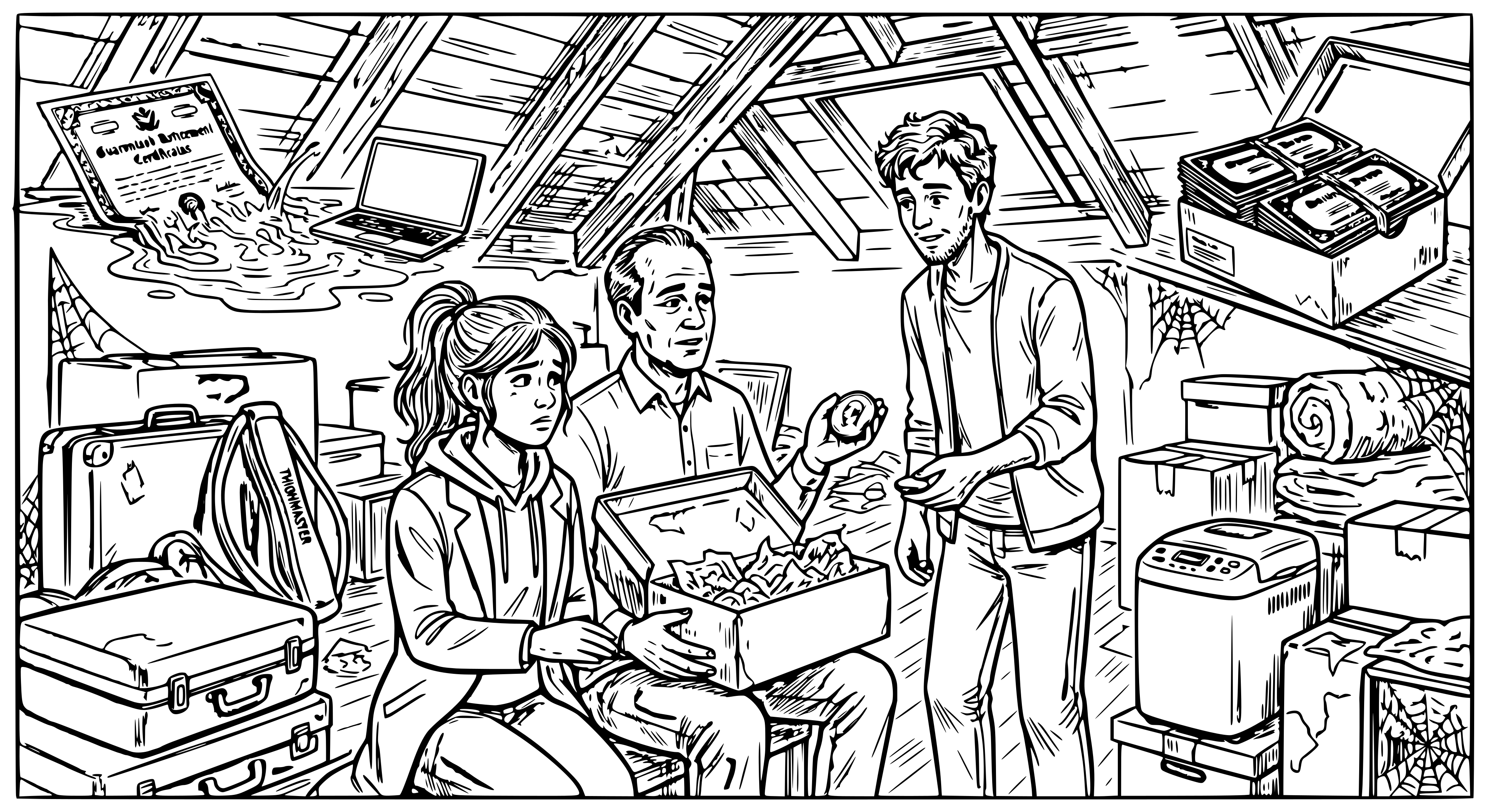
The attic was a graveyard for things that seemed like a revolutionary idea in 1998: ThighMasters and bread makers. Ria's father was currently wrestling with a stack of old suitcases. The air was thick with the scent of paternal nostalgia and fibreglass insulation.
As a data analyst, Ria's professional life was in the flickering pulse of cloud-based servers and predictive algorithms. She was used to things that were lightning-fast and entirely intangible. But the attic was different. Everything here was clunky, stubborn, and had a nasty habit of falling on your toes.
"Found it," her dad said with a dry chuckle, sliding a tattered shoebox across the floorboards. "The 1992 Master Plan. Pure, unadulterated optimism in a box."
Inside were neat bundles of Savings Bonds and "Guaranteed Retirement Certificates." They were crisp, embossed, and looked incredibly important, held together by rubber bands that had long since surrendered their elasticity and turned into sticky orange goo. Her father looked at the box with the amused grin of a man who'd finally spotted the sleight-of-hand at a magic show.
"I worked forty years of double shifts at the power plant to fill this box," he said, waving a bond like a winning lottery ticket from a defunct country. "Back then, this was a massive chunk of a house deposit. Now? It's basically the price of a mid-range laptop and a round of artisanal cocktails for the office. It turns out I wasn't saving for a house; I was subsidising the world's most expensive paper collection."
These bundles are paper promises. When a bank or government issues a bond, they are essentially borrowing now and promising to pay back later. The catch is the Great Eraser: inflation. They didn't have to break into the house to rob her father; they just diluted the currency until his life savings became the financial equivalent of a limited edition teddy bear. The denominations remained, but the purchasing power had been siphoned off.
The Paper Promise
"It's a bit of a classic, isn't it?" Ria said, laughing as she read the grandiose font on a certificate for a thousand pounds. She didn't need her predictive algorithms to tell her the maths was a joke; she could see the gap between the face value of the bonds and the soaring cost of the world outside.
"I thought I was building a lifeboat, Ria," her dad said, wiping a smudge of dust from his forehead. "I spent forty years huffing and puffing into this box, thinking it would keep me above the tide. But you can't build a boat out of promises. The numbers are all still there, but the floor has turned to mush. It's beautiful calligraphy, but it doesn't float."
The Real Deal
Rohan, Ria's brother, emerged from the hatch, shaking dust out of his hair. He'd been listening from the ladder. He reached into his pocket and pulled out a small, heavy object wrapped in a scrap of denim.
"Dad trusted the Paper World," Rohan said, handing the object to Ria. "I'm buying the Real Thing."
It was a gold bullion coin. It didn't have a screen, it didn't need a firmware update, and it didn't care about the central bank's feelings. It sat in her hand with a stubborn, ancient density that felt almost rude in its simplicity.
"Gold isn't a promise, Ria," Rohan said. "It's a physical fact. It doesn't have a 'Terms and Conditions' page because it is the value. If the cloud-based servers crash or the currency decides to identify as confetti tomorrow, this coin doesn't blink. It weighs exactly what it weighed when the Romans were using it to pay soldiers who were complaining about the exact same things we are." Ria felt the weight. In a world of "floating" exchange rates and "transitory" inflation, this was a fixed reality.
The Barbell Strategy
Ria looked from her father's box of expensive wallpaper to the heavy coin. Her data-brain started clicking into a new configuration: The Barbell Strategy. On one side, you keep your digital engine—the high-speed, high-reward world of tech, skills, and growth. That's how you outrun the bear. But on the other side, you need the weight. You keep a non-negotiable slice of your life in something that cannot be printed, deleted, or soaked through by a committee in a skyscraper. It's the counterweight that keeps your ship from turning into a kite when the paper economy starts to fly away.
The Mistake to Avoid
As Ria helped her father lower the shoebox back down, the mood shifted from nostalgia to a weird kind of freedom. He wasn't mourning the loss; he was glad he'd finally figured out how the trick worked.
She realised that being wealthy wasn't about having a high score on a banking app. It was about Self-Reliance—the ability to protect her time from being erased.
She restructured. She kept her high-speed career and her tech portfolio, but she established a hard floor. Every month, a portion of her earnings was moved out of the paper world and into the physical. She wasn't betting against the future; she was just making sure she'd actually be able to afford to live in it.
Walking out of the house, the city's neon signs and digital displays felt less like an inescapable storm and more like a very loud, very confused carnival. Below the noise, Ria was finally dropping her own heavy weights. She was no longer just a saver watching her boat turn to pulp. She was an Independent Scout, building a future on ground that stayed put—even when the rest of the world was busy floating away.
This story is for educational and illustrative purposes only. It does not constitute professional advice.