TL;DR
When global instability sends markets into a tailspin, data analyst Ria realises that financial fragility makes her a passenger in a crisis. Through a conversation with Mateo, a community gardener, she discovers the Resource Layer—the tangible world of energy, food, and materials. By securing her own foundation through practical skills and real-world assets, she moves from being a potential burden on a shaky system to becoming a resilient participant in a volatile world.
When Local Costs Meet Global Crisis
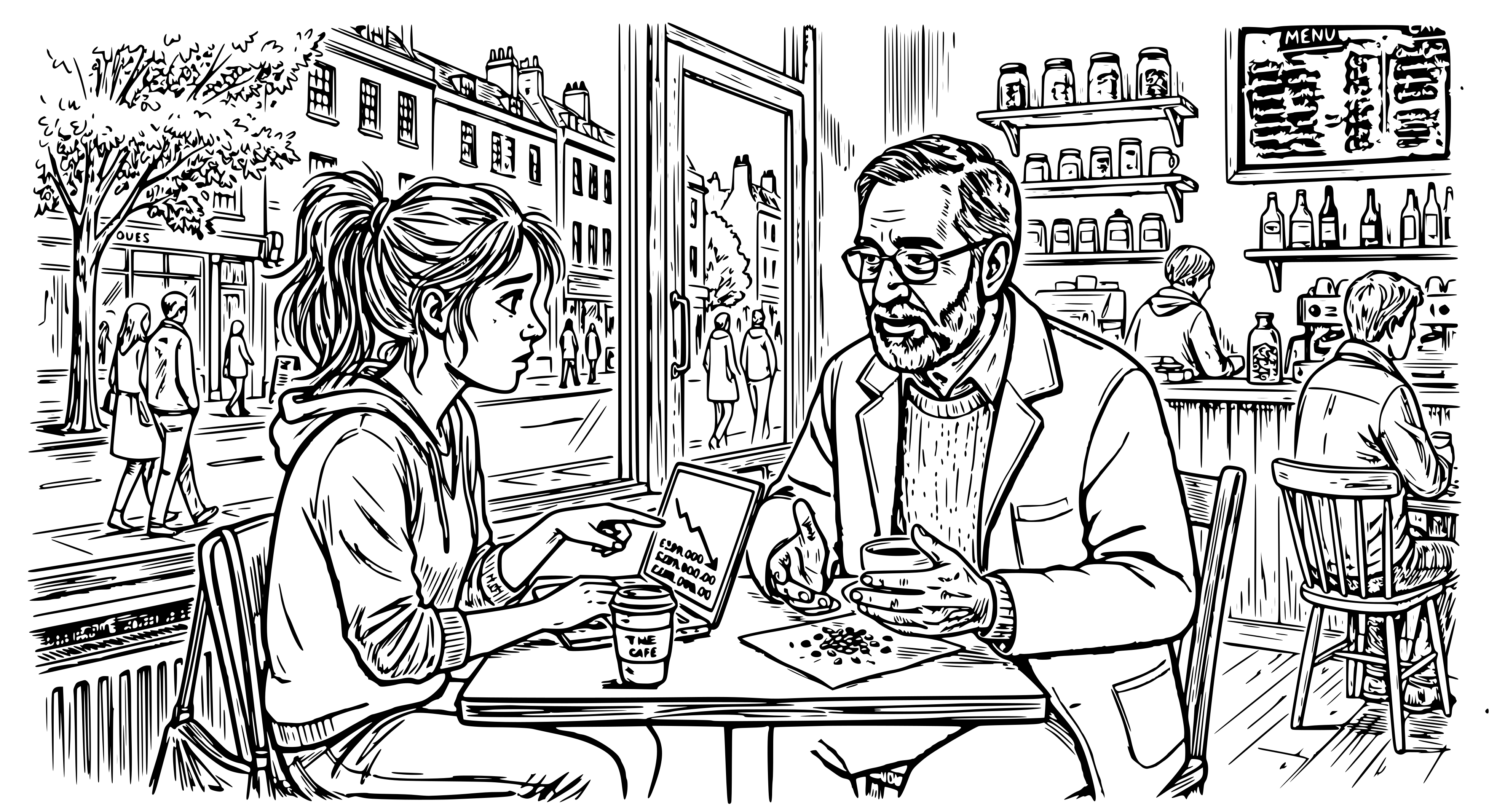
Ria sat in a quiet café, her eyes fixed on the single red arrow on her laptop. A geopolitical conflict had flared up thousands of miles away, and the ripples were hitting her home shores in real-time. The pound was dipping, energy stocks were spiking, and the purchasing power of her savings was retracting.
For a moment, she felt a flash of guilt for checking her bank balance while the world felt so heavy. But then, a colder realisation set in. If her currency lost its power and her costs spiralled, she would eventually lose the ability to take care of herself.
"It's not just about the money," she thought, refreshing the page. "It's about having some breathing room. If I have no buffer, I'm just another person who needs help. How can I be useful to anyone if I'm one bad month away from being a burden on a state that is already stretched to its limit?"
A Lesson from the Allotment
"You can't pour from an empty cup, Ria. And you can't build a house on a cloud."
Mateo sat across from her. He had spent his morning at the community allotment, clearing the last of the winter debris and prepping the soil for the spring. His hands were clean, but his fingernails bore the faint, honest staining of damp earth that never quite washes away. He'd brought a small batch of runner bean seeds with him to dry out in the warmth of the café, carefully spreading them across a paper napkin. He looked grounded, seemingly indifferent to the flickering digital tickers on the laptop.
"Technology has made us complacent," Mateo said, nudging a seed with a weathered finger. "We've spent decades thinking that as long as our apps work and our cards swipe, we are prepared. But a digital promise can't heat a room or grow a carrot. When the world shakes, people realise their wealth is just a digital layer. The most responsible thing you can do is to stop being a passenger and start securing the things that actually matter."
Finding the Economy's Foundation
Ria looked at the screen. "So, you're saying I need to start looking at what's under the bonnet of the economy?"
"Exactly," Mateo nodded. "Think of the economy like a pyramid. The top is the 'Paper World'—the currencies and stocks. It's noisy and fast. But the base? That's the Resource Layer. It's the energy, the food, and the raw materials. When conflict breaks out, the top of the pyramid shakes because the supply lines at the bottom are being squeezed."
"Foreign Exchange isn't just a game of numbers," Mateo explained. "You feel vulnerable because you're holding a currency that is currently losing its grip on the physical world."
Owning the Stuff, Not Just the Numbers
"But I'm a data analyst," Ria countered, leaning forward. "I don't own a forest or an oil well. I can't even afford a flat in this city. What does 'securing resources' look like for someone like me?"
Mateo smiled, sliding a runner bean seed towards her. "You don't need a country estate to build a foundation. You start with the investment layer. Instead of just holding cash that loses value while you sleep, you look at companies that own the 'stuff.' Think of the infrastructure that supports the next century—businesses that maintain the National Grid, or those developing smart-grid technology to help us manage energy more efficiently at home."
"So, investing in the systems that deliver the resources, rather than just the resources themselves?" Ria asked.
"Precisely," Mateo said. "And then you look at a tangible buffer. If a house is too far off, you look at the smaller rungs of the ladder. Some people hold physical gold as an emergency fund. Gold is generally stable and inflation-proof because it's a finite resource. While paper currency loses its edge every time the banks do a massive cash injection, gold tends to hold its ground. Others look at low-tech security: high-quality hand tools that last a lifetime, solar-rechargeable units with replaceable cells, or building a kitchen of long-life food. It's like pre-paying for your future needs so you aren't fighting for them when everyone else is. Things that actually hold their value and their function over time. It's not about making a quick profit; it's about making sure your hard work doesn't evaporate into thin air. "
Ria frowned slightly. "It sounds like you're telling me to become a survivalist."
"I'm telling you to become a specialist," Mateo corrected. "The most portable resource is what you can actually do. Technology has made us forget how to provide for ourselves because we've outsourced it all to an algorithm. If the internet went dark tomorrow, could you fix a basic leak? Could you grow a salad in a window box? Relearning those basic loops of energy, water, and food is the ultimate insurance policy. It means that if the system hits a crisis, you aren't a victim of it—you're a solution to it."
From Market Noise to Tangible Truth
The realisation shifted Ria's perspective from fear to focus. For years, she had treated her finances like a scoreboard. Now, she saw it as a toolkit. To be useful in a volatile world, she had to move her value closer to the foundation.
"So," Ria said, her mind already analysing data sets. "If the world is fighting over the Resource Layer, then the most responsible place for me to be isn't just holding cash. It's contributing to the systems that secure those resources locally."
Anchoring to the Real World
Ria closed her currency app. The red arrow was still there, but it was no longer a threat—it was an instruction.
She began to draft a new strategy. She shifted her long-term savings into specialised funds that focused on hard assets like sustainable timber, agricultural land, and the infrastructure that maintains the National Grid. These weren't just bets on a price; they were stakes in the physical world.
In her own life, she moved away from the digital complacency she'd grown used to. She signed up for a weekend workshop at Mateo's allotment, not because she expected a famine, but because she wanted to understand the Resource Layer of food first-hand. She even started to pre-pay her future costs by investing in high-quality, long-lasting gear, energy-efficient appliances that lowered her monthly overheads and gradually building up her supplies while prices were stable.
She was moving from a reactive mode to a proactive mode, building a foundation that didn't rely on a strong promise from a central bank. As she walked out of the café, she looked at the city and saw not just buildings, but energy systems and material flows. The world was still a messy, volatile place, but Ria was no longer a passenger. She had looked beneath the paper and found the stuff.
This story is for educational and illustrative purposes only. It does not constitute professional advice.