TL;DR
When a brilliant engineer risks everything on an unapproved neural patch to restore a patient's sense of touch, she achieves a miraculous breakthrough, but burns out her meticulous lab partner in the process. Six months later, she realises her wild leap only became a lasting, safe reality because her partner quietly re-engineered her volatile prototype for the real world, proving that true progress requires both fearless risk-takers and master builders.
The Safe Bet and the Wild Card
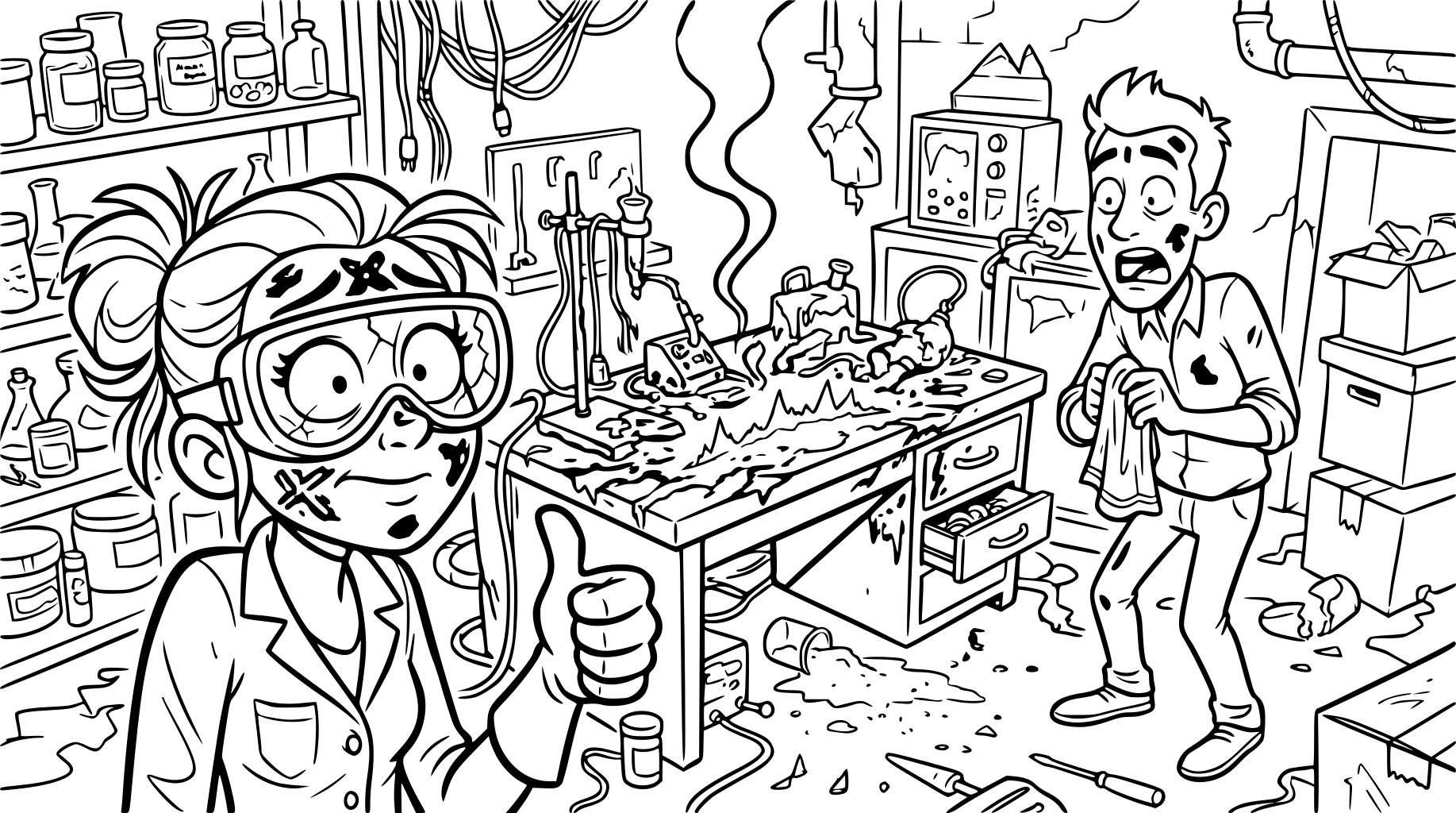
"I asked you to turn the power down, Tess, not trigger an artificial thunderstorm!" Mason shouted, frantically waving a damp tea towel at the acrid grey cloud wafting across the basement lab.
"Technically, the workbench hasn't caught fire," Tess said, peering round her oversized safety goggles with a soot-smeared nose. "It's just... re-contoured."
"It's glowing, Tess! The desk is literally glowing!"
"Consider it a mood light," she offered, flashing a weak smile.
For three years, their small Manchester lab had been locked in a quiet war of philosophy. Mason was the ultimate anchor: a meticulous technician who believed in steady, modest step-by-step improvements, strict safety protocols, and leaving work on time to see his daughter.
In mathematical terms, Mason lived happily in low variance. Imagine a factory that churns out identical slices of toast: every slice is predictable, safe, and utterly unexciting. You never get a burnt piece, but you'll never get a gourmet feast either.
Tess, on the other hand, lived out on the extreme edge of a fat-tailed distribution. A world where 99% of your attempts end up in the bin, but that final 1% breaks the universe wide open.
"You can't run a lab on wild gambles!" Mason groaned, fanning away the last of the smoke. "We need predictable data!"
"Predictable data is just a slow march towards mediocrity, Mason," Tess replied, wiping soot off her forehead. "Human progress isn't a straight line. It's a series of explosions. Usually metaphorical, sometimes on our workbench."
Their clash reached a boiling point when the grant money ran out. Facing imminent shutdown, they had one final trial patient booked: Roy, a former electrician who had lost his forearm in an industrial accident six years prior.
The Giant Leap
Under the official roadmap, Mason had prepared a safe, standard motorised claw. A reliable device that would secure them a modest extension on their funding. But the night before the trial, Tess made her choice.
She stayed behind, bypassed the safety review board, and retrofitted the arm with her experimental neural patch. A radical design engineered to feed sensory signals directly into the nervous system.
When Mason arrived the next morning and spotted the altered arm, he nearly dropped his mug. "Tell me you didn't."
"I upgraded it," Tess said innocently.
"You've risked the entire grant, our licences, and this man's safety!" he hissed, his voice dropping to an angry whisper. "The safety board approved a claw, Tess. A simple, predictable claw!"
"A claw is a tiny improvement, Mason!" Tess snapped back, her eyes burning with pure drive. "That's purely linear growth. It ignores everything we've already built. It just adds the exact same fixed amount whether you're starting from scratch or years into the work. It's like adding exactly one pea to your dinner plate every day. It takes forever to fill the plate."
"Linear growth keeps people safe!"
"And Power Law growth changes the world!" Tess countered, leaning over the desk. "Think of how power laws work: a million video clips get three views, but one extreme outlier gets two billion. In science, a thousand tiny, sensible tweaks will give you a slightly better gadget. But one crazy, high-risk leap can dominate the entire outcome and eliminate a disability forever. We have to roll the dice."
Before Mason could pull the plug on her experiment, the door opened and Roy walked into the lab.
The Cost and the Breakthrough
The trial was pure, high-stakes probability. As Tess wired the neural patch to Roy's arm, Mason hovered over the big red emergency shut-off switch, his knuckles white.
"Voltages are spiking," Mason warned, eyes glued to the monitor. "Tess, we're hitting upper tolerances. If this surges, we fry the chip and our careers in one hit."
"Hold the line, Mason," Tess murmured, adjusting a dial with micro-precision. "Give the system a second to find equilibrium."
"It's creeping into the red zone... 88%... 92%..."
"Just five seconds," she pleaded.
Tess initiated the full neural sequence. For ten agonising seconds, the lab was dead silent, bar the hum of the cooling fans. Mason's thumb hovered a millimetre above the shut-off button.
Then, Tess reached into her pocket, pulled out a strip of velvet ribbon, and gently brushed it across the synthetic fingers.
Roy froze. His eyes went wide, and his hand flew to his mouth as tears welled up.
"Roy?" Mason asked softly, his finger still glued to the switch. "Are you alright? Is it hurting?"
"I... I can feel that," Roy whispered, his voice cracking with a mix of shock and joy. "It's soft. And... crikey, it's warm. I can actually feel the texture!"
Tess let out a breath she felt like she'd been holding for three years. The neural patch worked. It was a staggering triumph.
Yet, the victory bore an immediate price. That evening, after Roy had left floating on cloud nine, Mason quietly packed his toolbox.
"You did it, Tess. It's a miracle," Mason said, placing a handwritten letter on her desk. "But I can't live in the red zone. My heart can't take the volatility."
"Mason, wait. We won!" Tess protested, rising from her chair.
"You won the gamble," Mason corrected gently. "But you can't build a sustainable future if every single day is an all-or-nothing roll of the dice."
He handed in his resignation, leaving Tess to celebrate her historic breakthrough in an empty, quiet lab.
Making the Flying Machine Safe
Six months later, at a grand medical technology conference in London, Roy walked onto the main stage. Before an audience of hundreds, he picked up a glass, poured a drink without spilling a drop, and signed his name on a digital tablet with effortless grace. The room erupted into a standing ovation.
Standing at the back of the auditorium, Tess beamed with pride as the crowd cheered. But as her eyes scanned the hall, she spotted a familiar face sitting in the second row.
Mason.
After resigning, Mason hadn't quit the field; he had taken a senior job with the medical manufacturing firm contracted to produce Tess' design. Over the past six months, while Tess was off giving speeches and chasing funding, Mason had been doing what he did best. He had systematically dismantled her chaotic prototype, stripped out the dangerous voltage spikes, added triple-redundant safety fuses, and streamlined the manufacturing process.
Tess' wild idea was brilliant, but Mason had made it safe, affordable, and ready for thousands of patients across the country.
As the applause swelled, Mason turned, caught Tess' eye across the crowded room, and gave her an amused smile and a nod.
Tess smiled back as the truth hit her. Her crazy leap had unlocked the door, but it was Mason's quiet, disciplined work that actually built the staircase for everyone else to climb.
Her breakthrough was never a solo victory. It was a team effort. Humanity doesn't just need the wild cannonballs who dare to reach for the stars; it needs the steady anchors who make sure we don't crash on the way up.
This story is for educational and illustrative purposes only. It does not constitute professional advice.