TL;DR
When a precision-driven woman tries to spreadsheet her way into the perfect time to have a baby, she realises that no mathematical model can guarantee zero risk. By shifting her mindset from fragile perfection to real-world robustness, she learns to let go of absolute control, delete her models, and step into the unknown with her partner.
The Parenthood Equation
Kate viewed the prospect of motherhood not as a heartwarming milestone, but as a giant, terrifying, non-refundable life plot twist. She called it the "18-year accident": a decades-long hurricane set to blow through her beautifully organised world.
At thirty-two, Kate was a master of precision. Her life with her partner, Danielle, ran like a finely tuned Swiss watch. Their relationship was governed by shared calendar invites and synchronised weekend fitness routines. They had a pristine flat, gorgeous mid-century furniture without a single scratch, and quiet Sunday mornings that flowed with total, predictable peace.
But lately, her brain's internal dashboard was flashing a warning light. Everywhere she looked, society was marketing the "perfect family life." Friends were posting photos of serene nurseries, and Danielle was eyeing their spare room with a hopeful look.
Kate found herself trapped in a classic psychological loop: she was "wanting to want" a baby. She didn't actually want the sleepless nights or the total loss of her freedom. But she felt like she should want it. Underneath the logic, though, was a much deeper, quieter fear. She was terrified that if she finally decided she was ready, her body wouldn't cooperate and she wouldn't even be able to conceive. And even if she did, what if she was simply terrible at being a mum? What if she couldn't handle the sheer, overwhelming weight of motherhood?
The Illusion of the Perfect Plan
To fix her paralysis, Kate did what she always did: she looked for a safety net made of data. She built a massive, secret spreadsheet on her laptop, attempting to calculate an inherently chaotic human experience.
She tracked childcare costs, sleep deprivation statistics, and read endless parenting forums to find the absolute optimal time to make the jump. She wanted a guarantee that she wouldn't fail.
One evening, Danielle walked into the kitchen and found her staring at a complex chart plotting her remaining fertility window against their mortgage timeline.
"Kate," Danielle said gently, setting a cup of tea next to her. "You're trying to solve an equation that doesn't have a fixed answer. You can't run a simulation on a person who isn't here yet."
"I am trying to protect us, Danielle," Kate said, her voice tight. "A child isn't something you can try out and return if it's too difficult. What if we commit to this, and my body fails us? I see what our friends went through: the heartbreak of trying for years, the doctors, the quiet grief of wanting a family and facing empty rooms. It makes me want to lock the door and keep everything exactly as it is where no one can get hurt."
Danielle sat down beside her, taking her hand. "The people who face that struggle are some of the bravest people on earth because they risk their hearts completely. But staying exactly as we are just to avoid being vulnerable? That's a different kind of risk. You're betting that keeping life completely predictable will somehow make us happy forever."
The Stress Test
After Danielle went to bed, Kate sat in the quiet living room. She closed the laptop lid. She realised she was confusing two fundamental system concepts: optimisation and robustness.
Optimisation demands pristine, controlled conditions. If one parameter shifts slightly, the whole fragile system fails. Robustness, on the other hand, doesn't care about perfect conditions. A robust system is designed to absorb noise, weather high variance, and adapt when real-world conditions deviate from the script.
Kate looked at the maths of her own fear:
The Fragile System (Status Quo): Optimised for zero noise. Highly vulnerable to regret, unexpected changes, and missing out on an entirely unique dimension of human love.
The Robust System (The 18-Year Decision): Designed for variance. It acknowledges that the fertility process might be unpredictable, that toddlers spill everything, and that sleep schedules will fail. But instead of breaking under the noise, a robust relationship absorbs the shocks and grows around them.
The price of absolute optimisation was complete paralysis. To live a full life, she didn't need a sensitive model with zero error margins. She needed to trust that she and Danielle were robust enough to handle whatever variance came their way.
Stepping into the Variance
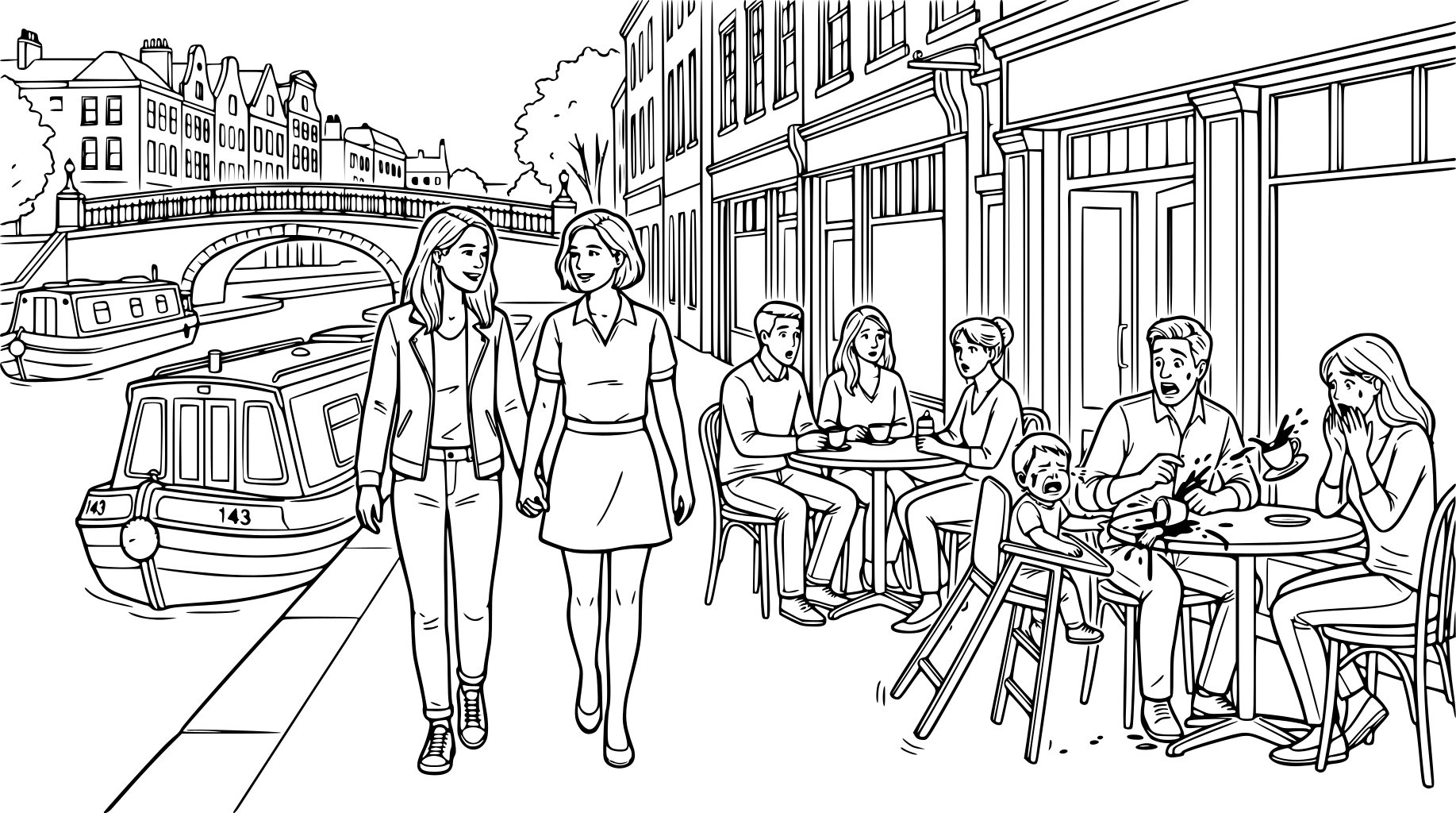
The next morning, Kate left her laptop closed. She and Danielle went for a walk along the canal. The sky was an unpredictable, volatile grey, threatening rain, but she hadn't even checked her weather app before leaving the flat.
They passed a small café where a young couple were attempting to navigate brunch with a crying toddler and a spilled cup of coffee. A year ago, Kate would have looked at that scene as a failed system and a warning to run back to her quiet flat.
But today, looking at the parents laughing tiredly as they wiped down the table, she saw something else. She saw two people whose lives had absorbed the chaos without breaking.
She stopped walking and turned to Danielle. Her heart was beating with a strange, unfamiliar rhythm. Not the tight panic of anxiety, but the expansive flutter of a real choice.
"Danielle," she said, her voice steady despite the complete lack of a backup plan. "Let's delete the spreadsheets."
Danielle blinked, a small smile starting to form. "All of them?"
"All of them," Kate said, letting go of the rigid character she had played for a decade. "We don't need to optimise for every variable, and we can't control what the future holds. Whether it's easy, or whether it's a long, tough road for us to get there, we are strong enough to adapt. Let's make the 18-year decision. Let's just step out into the unknown together."
Danielle's face broke into a wide, relieved smile, and she pulled her into a tight hug. As the first unexpected drops of rain began to fall, Kate didn't run for cover. The safety trap was broken, the control was gone, and she was entirely ready to see what happened next.
This story is for educational and illustrative purposes only. It does not constitute professional advice.