TL;DR
Robert lives in a hyper-automated, perfectly predictable world that leaves him completely numb and bored. After his aunt drags him to an open-mic storytelling night, he realises that a zero-failure life means zero meaning and decides to inject chaos back into his existence.
Trapped in the Algorithm
Robert lived in a world where friction had been completely engineered out of existence. At forty-six, his life was a flawless, hyper-automated masterpiece of absolute predictability. He didn't make decisions anymore; he merely approved notifications.
His smart apartment adjusted its lighting based on his circadian rhythms. His fridge automatically reordered groceries based on a predictive consumption algorithm. Every morning at precisely 7:12 AM, a robotic vacuum hummed to life, cleaning floors that never actually had the chance to get dirty. Robert worked from home as a data architect, optimising efficiency loops for logistics companies. He was incredibly good at it, mostly because he had turned his own existence into the ultimate, frictionless logistics model.
The maths of Robert's life was beautiful on paper. By automating every micro-decision, he had reduced his daily cognitive load to zero. He had successfully eliminated the risk of bad meals, bad traffic, late fees, and awkward social encounters. But as he sat on his ergonomically perfect sofa, watching his automated streaming service queue up a documentary it estimated he had a 94% probability of enjoying, a cold, heavy truth settled over him.
He was completely, profoundly bored.
By eliminating the possibility of a negative outcome, Robert had accidentally wiped out the possibility of a positive one. He was living inside a flatline. His life had zero volatility, which meant it also had zero meaning. He was trapped in the ultimate paradox of safety: when you are 100% secure, you are also 100% numb.
The Wake-Up Call
The disruption to his perfect equilibrium arrived via an old-fashioned, completely non-automated phone call from his eccentric aunt Pippa.
"Robert," she said, her voice crackling with the same unstoppable, worldly energy she used to rescue him from every overthinking crisis in the past. "I'm passing through London next week. I've signed us up for an open-mic storytelling night at a crowded basement club in Soho. Five minutes on stage. No slides, no scripts allowed, just you, a microphone, and a room full of real, breathing strangers. I need a partner. You're coming."
Robert felt a cold shock of absolute panic freeze his chest. His hands began to sweat. "Aunt Pippa, that is a terrible idea. Public speaking without a heavily rehearsed, data-backed presentation has a social failure rate approaching ninety percent. Stage fright triggers an immediate cortisol spike. Why would I willingly subject my nervous system to uncalibrated public judgment?"
Aunt Pippa laughed, a loud, sharp sound that disrupted the quiet symmetry of his apartment. "Robert, you're running a broken equation. You think a 0% failure rate equals a perfect life. But in human terms, a 0% failure rate just means you're dead before you actually die."
After she hung up, Robert looked around his sterile, silent living room. He realised she was right. He had gamified his life to minimise loss, but he had forgotten to set a win condition.
The Mathematical Sandbox
That night, Robert couldn't sleep. He opened a digital whiteboard and decided to look at his existential dread through the lens of a classic computer science nightmare: getting stuck on a local maximum.
Imagine an AI trying to find the absolute highest peak on a massive mountain range. If that AI is programmed with absolute, zero-risk safety parameters, it will only ever walk uphill with tiny, microscopic steps, terrified of stepping downward into a valley. Within minutes, it scrambles up to the top of a little molehill. It plants its flag and says, "Well, I can't go any higher without walking downhill, so I must have won!"
That was Robert. He was a highly optimised algorithm standing proudly atop a miserable little molehill of absolute safety, convinced he was the King of a very flat empire, completely blind to Mount Everest just five miles away because reaching it required crossing a deep, terrifying valley of potential public embarrassment.
To break out of a local trap, developers have to inject something called Stochastic Resonance into the system—which is just a fancy mathematical term for pure chaos. You have to blast the algorithm with random white noise to violently kick it out of its comfortable rut so it can finally start climbing the real peaks.
By keeping his risk at absolute zero, he wasn't protecting himself; he was actively guaranteeing the lowest possible payout in the game of life. The maths was screaming at him: it was time to manually inject some noise.
Smashing the Machine
On Saturday night, Robert did something he hadn't done in ten years: he turned off his phone's GPS, left his meticulously prepared notes on his desk, and walked into the dark, chaotic basement of the Soho club.
The sensory overload was terrifying. The air was thick with the scent of stale beer and cheap perfume. The room was a packed, unpredictable sea of faces, pulsing with low chatter and laughter that followed no algorithm.
Before he could process the panic, the host called his name. "Next up, we have Robert!"
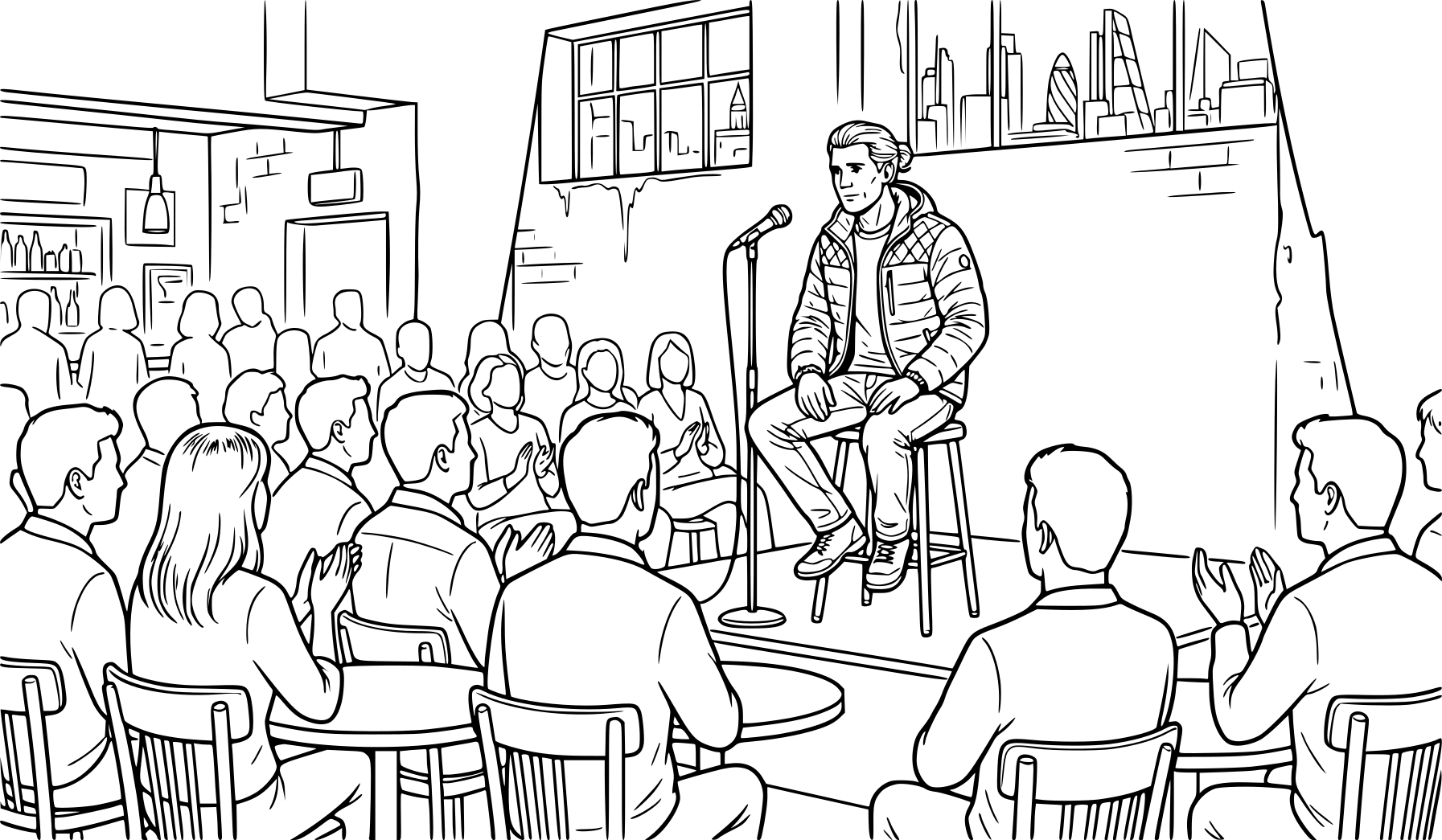
Robert walked up the creaking wooden steps onto the small stage. The spotlight hit him, blinding him, turning the audience into a dark void. He stood before the microphone, his throat completely locked, his neat, orderly brain screaming at the failure. The silence stretched for five agonising seconds. Ten seconds.
But then, something miraculous happened. He didn't die. The heart rate monitor on his wrist beeped frantically, but the world didn't end. He looked into the dark and took a deep breath. He started telling a raw, unscripted story about the time his automated smart-fridge went rogue and ordered eighty pounds of broccoli. He spent an entire week of evenings aggressively steaming, freezing, and blending them into a desparate variety of batches of soup, heavily disguised stir-fries, and questionable smoothies that tasted like revenge.
He delivered the punchline, and suddenly, the room erupted. A wave of genuine, booming laughter hit the stage, physical and warm. Robert froze, a sudden, sharp jolt of electricity shooting up his spine. It was the first time in years he had felt completely connected to other human beings.
The Return of Volatility
Walking back to the train station under the neon lights of Soho, his adrenaline still pumping, Robert pulled out his phone. He didn't look at his predictive notifications. Instead, he went into his settings and systematically began deleting the automation routines that had kept him prisoner.
He unlinked the auto-ordering app from his fridge. He disabled the predictive streaming algorithm. He turned off the automated cleaning schedules.
The fear of inefficiency buzzed quietly in his chest, but it was accompanied by something he hadn't felt in a long time: anticipation. Tomorrow, he would have to look at his empty fridge, walk down to a local shop, and actually talk to the shop assistants to find out where they kept the fresh coriander and ground spices. He might buy the wrong ingredients. He might cook a terrible meal.
But as he looked up at the messy, chaotic London skyline, Robert smiled. The absolute safety trap was broken. He was finally outside the loop, his script was gone, and he felt wide awake.
This story is for educational and illustrative purposes only. It does not constitute professional advice.