TL;DR
Lucy hid behind spreadsheets and app algorithms to avoid the risk of real-life romance. When she finally calculates the true cost of staying safe versus asking her long-time colleague Chris out, she realises the smartest move is taking a chance.
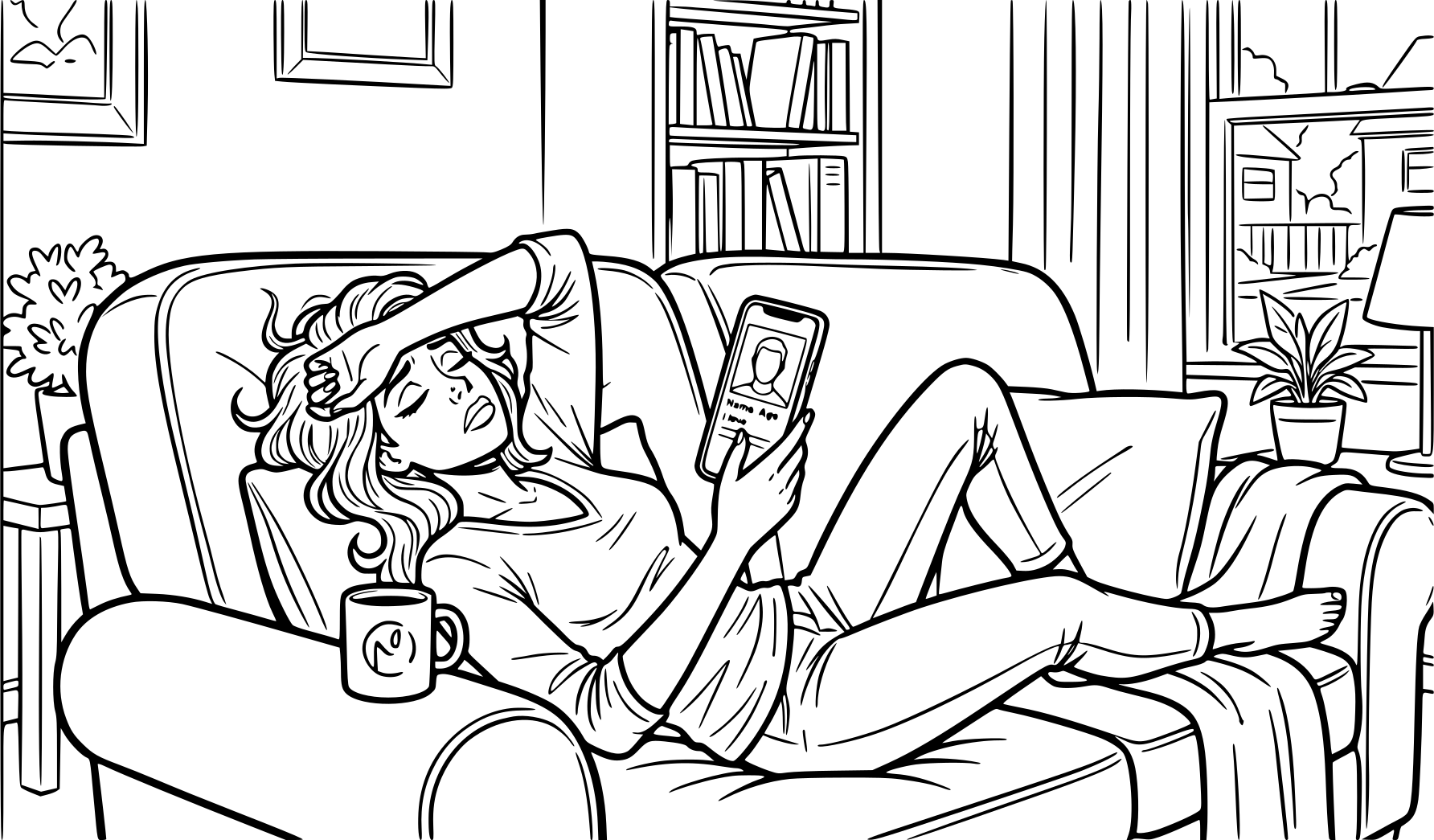
The Infinite Swipe
Lucy felt like modern romance was less of a fairy tale and more of a rigged arcade game designed to eat your money. Her dating life was an exhausting cycle played out in fifteen-minute increments on a phone screen with a crack right through the middle. Every evening, she sat on her sofa swiping through profiles, feeding her precious time into the app like tokens into a machine: hoping for a jackpot, but just walking away with a cheap stuffed toy no one wanted.
The maths of the apps felt freezing cold. You swiped, you matched, you exchanged three days of painful, uninspired banter about favourite vegetables, and then you went to a deafening bar to meet a stranger who looked roughly forty percent like their photos. If the date flopped, Lucy didn't just mourn the lost hours, she held a full military funeral for her wasted youth. Two precious hours gone forever, fifteen quid incinerated on a gin and tonic that tasted like melted ice and regret, and a fresh, bulletproof crust of cynicism welded onto her already blackened soul.
Everyone was hunting for a flawless, mythical soulmate, trapped by a maths puzzle called the "secretary problem." It's actually the statistically optimal strategy for finding a candidate out of a list: reject the first 37% to see what's out there, then hire the next person who beats the group. But on dating apps, people just keep swiping past their 37%, endlessly searching for a theoretical optimum and missing the real-world matches who already fit what they're looking for. The conveyor belt never stops. Her friends thought she was picky; in reality, swiping was her shield. It was infinitely safer to judge low-effort profiles than to admit what, or who, she actually wanted. Lucy had become a master at keeping conversations superficial and her emotional walls covered in barbed wire.
The Plot Twist at the Printer
Lucy's remarkably boring Tuesday afternoon at the architecture firm hit a wall when the office printer jammed for the third time. She was standing over it, trying to stare a hole through a complex floor plan that had completely ruined her afternoon, when Chris walked over holding two mugs of coffee.
Chris was the firm's Senior Structural Engineer. He had been there five years, three longer than Lucy, and basically held the structural department together with stubbornness and endless caffeine. He didn't look like a heavily filtered profile picture, and his bio wasn't a list of sarcastic red flags. He was just Chris: the guy who always knew how to fix her load-bearing calculations, shared her ridiculously niche passion for brutalist concrete, and had been a steady, reassuring presence in her daily life for two years.
As he handed over the mug, their fingers brushed. Lucy was hit by a sudden, terrifying wave of physical warmth. She looked up and really looked at him, at the laugh lines around his pale grey eyes, and the quiet, no-nonsense confidence he carried through the chaotic office.
Every thought in her head slammed on its brakes and crashed into the back of each other. She hadn't just noticed him today; she had spent twenty-four straight months watching him exceed every quality she'd been swiping endlessly to find on her phone. Because he was a senior colleague, her brain had instantly panic-sorted him into a safe, untouchable box. She had spent two years pretending he was just "the guy who knows about steel beams," completely blinding herself to the irritatingly handsome human being sitting thirty feet away.
The Panic Room of Rationalisation
Acknowledging her crush on Chris triggered a full-blown internal emergency. Flirting with a colleague you could see every day is a thousand times more terrifying than getting ghosted by a stranger named Chad online.
Her brain, sensing imminent emotional danger, immediately began doing what human brains do best: manufacturing deeply dramatic, totally illogical excuses. Within thirty seconds, Lucy rationalised her way straight back into denial.
"He's senior to me,” she muttered internally, nodding like a sensible adult. “He's practically part of the office plasterboard. What if we break up? I'll have to quit. I'll have to move to a remote fishing village. I'll have to fake my own death and change my name to Brenda! Yes, staying single and on the apps is clearly the mature, rational choice."
She was a professional at lying to herself. Her brain happily ignored the massive upside, all to avoid thirty seconds of potential awkwardness by the water cooler.
The Expected Value of Romance
That night, sitting at her kitchen island with a glass of wine, Lucy decided to treat her feelings like a high-stakes poker game using a concept called Expected Value. To figure out if a bet is worth making, you weigh the potential cost of losing against the size of the jackpot.
If her sanity were represented by a stack of poker chips, the dating apps were a guaranteed, slow-bleed trap—costing her ten chips a week for zero payout. Asking Chris out, on the other hand, carried real risk. If it flopped spectacularly and ruined work meetings, she'd lose a hundred chips to pure awkwardness. If they tried one date and realised they were better off as friends, she'd lose five. But if it worked? If it actually worked out with someone who already understood her world and made her laugh, the jackpot was ten thousand chips.
The maths was ruthless: even if the odds of awkwardness were high, the massive payout completely crushed the risk. The real danger wasn't getting turned down; it was staying stuck in an endless stream of 'Hey' messages out of pure fear.
Dropping the Spreadsheet
By Friday drinks at the local pub, knowing the maths didn't make her legs feel any less like lead. Every time she opened her mouth to speak to Chris, her vocal cords went on strike.
Then it hit her: the exact same gridlock could be paralysing him too. Chris wasn't a mind reader. If she had been projecting cold, professional boundaries for two years to protect herself, he would have done his own risk assessment. For a senior engineer to risk making a junior colleague feel uncomfortable was a massive boundary jump. The logic was clear: if anyone was going to break the standoff safely, it had to be her.
Twice, she almost grabbed her coat and bolted back to the safety of her sofa. But as the pub crowd finally thinned out, leaving just the two of them by the window, she took a breath and jumped.
"Chris," she said, her voice shaking slightly as she ditched her polished corporate tone. She locked eyes with him before her brain could talk her out of it. "Are you free Sunday? ...For a date?"
Chris froze, his pint glass hovered midway to his mouth. He blinked, set his drink down slowly, and let out a soft laugh as a smirk spread across his face.
"Wait, so I spent the last two years thinking you just really loved concrete, and you were actually trying to flirt?" He shook his head, leaning back in his chair with a sly grin. "Honestly, I was starting to think I'd have to invent a structural emergency just to get your phone number. So yeah, I'm definitely free on Sunday."
Lucy finally exhaled a breath she'd been holding since Tuesday.
Later that night, back home on her sofa, she unlocked her phone. She stared at the grid of bright dating app icons on her screen, held her thumb down until they started to wiggle, and deleted every single one. Monday morning at the office was going to be interesting. But the maths was entirely in her favour.
This story is for educational and illustrative purposes only. It does not constitute professional advice.