TL;DR
Relying on one boss is the greatest risk in an economy defined by automation and shrinking roles. This story follows Theo's pivot from a fragile single-income stream to a Portfolio Career, proving that modern security isn't found in a job title, but in owning your own toolkit.
The Single-Income Trap
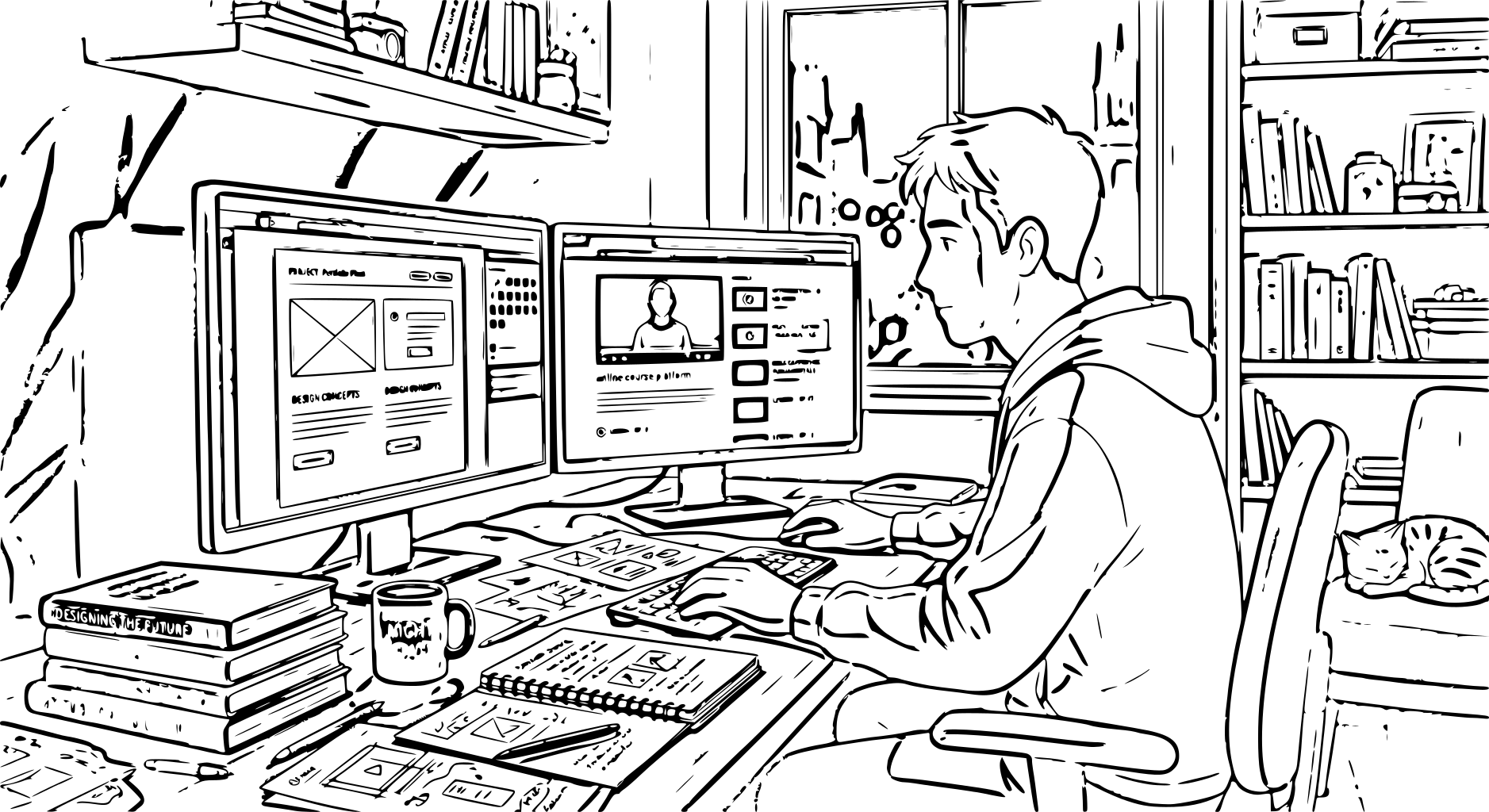
Theo stood by the window of his home office, watching a small delivery robot whir down the pavement. It was a clever piece of kit, navigating the kerbs with more precision than most pedestrians. But to Theo, it was a silent signal that the ground was moving under his feet.
The morning news was full of talk about "automation" and "shrinking roles", but he didn't need a headline to tell him that. He could see it in the quiet, empty desks at his firm and the way the younger staff looked a little more anxious each month. For a long time, the plan had been simple: get a good job, work hard, and the rest would take care of itself. But that "9-to-5" promise was starting to fray. As the cost of running a business went up, companies were looking for digital ways to replace human hands. For his younger colleagues, it felt like the ladder was being pulled up just as they reached for the first rung.
The Single Payslip Risk
Theo realised that putting all his eggs in one basket—relying on a single boss for a single payslip—felt riskier than it used to. In the past, you'd get a job, work your way up the ladder, and that was that. But the ladder didn't feel very sturdy anymore. If his office decided to "restructure" or a new piece of software made his role redundant, he'd be left with nothing.
He needed to stop thinking of his job as his only lifeline. He still worked his 9-to-5 in the IT department, keeping the company's systems running, but he started looking at it differently. It was his main source of income, sure, but it wasn't the only thing he could do. He started looking at his skills as a toolkit he could use in more than one place, just in case the weather changed at work.
The Late-Night Slog
His evenings, which used to be spent slumped on the sofa, were now dedicated to a different kind of work. Theo had always been a decent photographer, but turning that into something that actually made money was a grind. He spent months of late nights hunched over his laptop, refining a set of photo editing "presets" that would help other people get the same look.
It wasn't a quick win. He spent hours wrestling with website templates that refused to align, tweaking the contrast and grain on fifty different images to ensure the files worked for everyone, and learning how to use the right keywords so his shop wouldn't just vanish into the depths of a Google search. He'd almost given up twice, convinced he was just shouting into a void. But then, while he was in the kitchen putting the kettle on, his phone buzzed. A notification told him he'd made his first sale to someone in Bristol. It was only a few quid, but it changed everything. It was proof that he didn't have to wait for a boss to give him permission to earn.
The Two-Speed World
The world wasn't growing at the same pace for everyone. Theo could see a divide opening up, like a motorway splitting into two different directions. On one side, people were leaning into the new tech, finding ways to make it work for them. On the other, traditional roles were struggling to keep the lights on under the weight of rising costs and falling confidence. Theo knew that to stay on the right side of that divide, he had to be adaptable.
He started teaching himself how to use the very AI tools that were making his colleagues nervous. If the robots were going to be the ones delivering the parcels, Theo wanted to be the one who understood how to map their routes. He realised that the most valuable asset he owned wasn't his degree or his years of service; it was his ability to learn a new skill and pivot when the wind changed direction.
A New Kind of Stability
As the sun set, the feeling of "just about managing" felt a little more distant. He wasn't waiting for the world to go back to "normal" or for the old 9-to-5 stability to return. He was building a new kind of security, one that didn't depend on the whims of a single boss or a single industry.
He realised that anyone could start building their own "portfolio" by simply looking at the things they already did for free—whether it was organising complex rotas, having a knack for writing words that cut through the jargon, or even just knowing how to fix a specific type of software glitch—and finding a way to package that knowledge for someone else.
By spreading his skills across different areas, he'd turned the uncertainty of the job market into a source of freedom. He was no longer just an employee waiting for a set of instructions; he was the pilot of his own ship. The world was volatile, and the weather was changing fast, but Theo had learned that the best way to handle a storm isn't to hope for clear skies—it's to make sure you have more than one way to stay afloat.
This story is for educational and illustrative purposes only. It does not constitute professional advice.