TL;DR
Detective Ruth thought her city's web of smart doorcams and AI lightbulbs was a triumph when a doorbell camera helped locate a missing teenager. But when a neighbour's automated porch camera misinterprets a jogger as a fleeing suspect, she realises the public has built the world's most hyperactive police state—and paid for the hardware themselves.
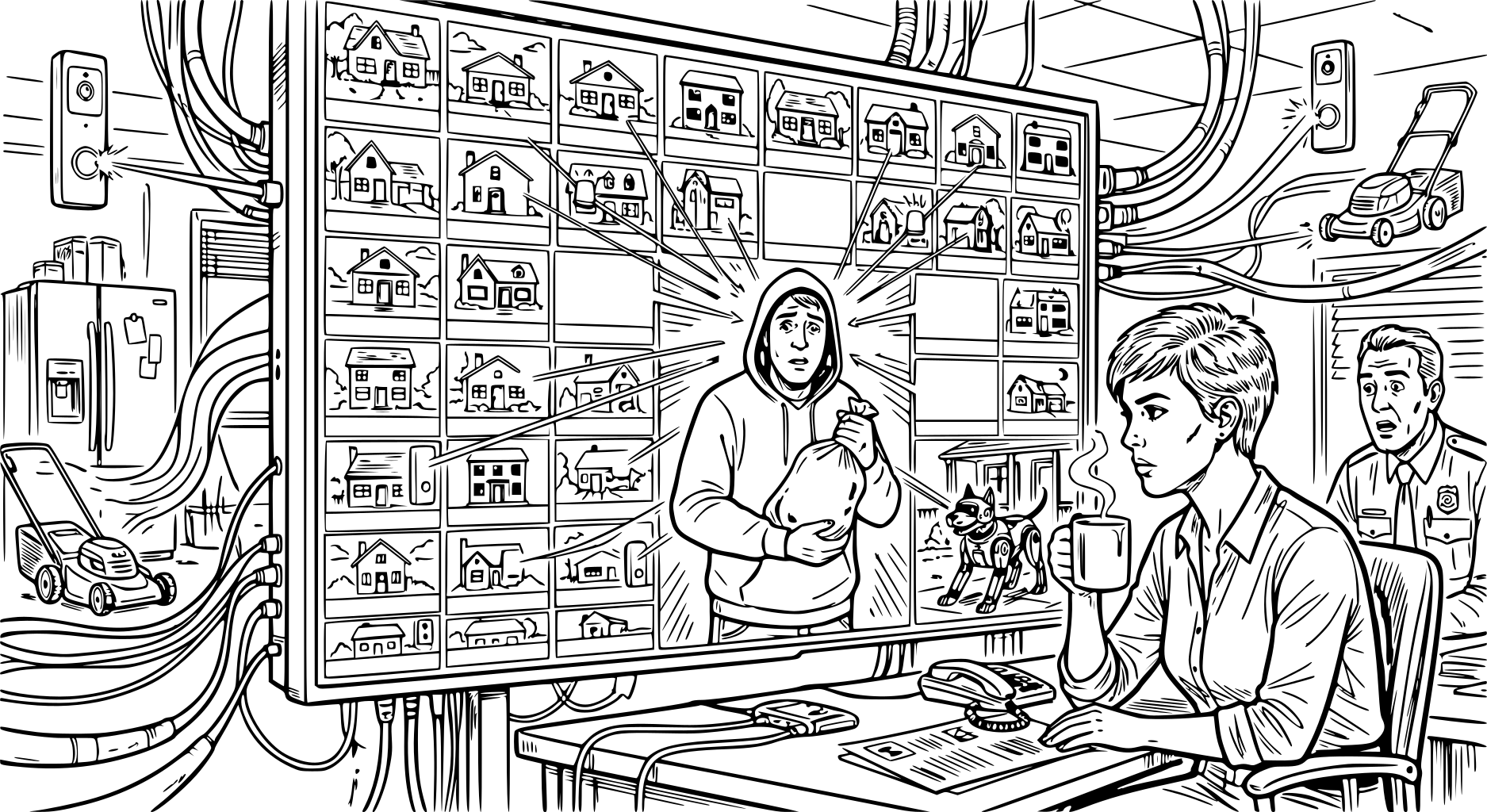
The Neighbourhood Watch on Steroids
Detective Ruth viewed modern smart surveillance as a chaotic, non-stop comedy show broadcast in sharp high definition.
Where public warnings and news headlines always talked of terrifying government supercomputers, reality was far more absurd: citizens were happily buying, unboxing, and mounting their own digital spies straight onto their front doors. The high street wasn't monitored by hidden spy cameras in secret corners, but by an army of sleek, plastic doorcams, smart fridges, AI-powered bird feeders, and robotic lawnmowers—all politely reporting their surroundings back to corporate cloud servers twenty-four hours a day.
Ruth wasn't complaining. In law enforcement, this volunteer civilian spy network was an absolute goldmine. She didn't need a high-level court warrant or a black-budget satellite when Mrs Taylor at number 42 had a motion-activated doorbell that recorded every squirrel, milk delivery, and passing cloud in crisp 4K resolution.
The brilliance of the system proved itself on a freezing Tuesday at 3:00 AM.
Fourteen-year-old Archie had slipped out of his bedroom window after a huge row with his parents over screen time. Outside, the temperature was plunging, and the teenager was wandering without a coat.
Ruth sat at her station desk, nursing a steaming mug of tea, and fired up the local digital canvas. She didn't hack state satellites. She simply pinged the neighbourhood's emergency portal.
First came a two-second clip from a smart doorbell on Church Road, capturing a flash of Archie's neon-yellow trainers. Next, an AI-enabled driveway security light two streets over detected "unusual night movement" and lit the boy up like a West End stage production. Finally, a smart garage door camera across the park caught him sitting shivering inside a bus shelter.
Within forty minutes, Ruth despatched a patrol car, and Archie was back home, wrapped in a blanket, drinking warm tea.
Ruth grinned, tossing her paper cup into the bin. The system was magnificent. Resident paranoia had turned the entire town into a collective guardian angel.
The Algorithmic Frame-Up
The honeymoon lasted precisely nine days.
At 2:00 PM on a grey Thursday, the station's automated threat dashboard began blaring like a fire engine. A high-end residential street had just reported an aggravated burglary, and the neighbourhood's crowdsourced safety network was on high alert.
Ruth pulled up the live feed from the scene. A brand-new, top-of-the-range smart doorcam—owned by a local tax consultant who was currently on holiday in Spain—had automatically flagged a "suspicious high-risk entity" fleeing the crime scene.
The automated system had already bundled the footage, logged the timestamps, and auto-forwarded the file directly to the station's investigative queue. Attached was a predictive confidence score of 98.4%.
On the monitor, the video showed a man in a dark hoodie running frantically down the pavement, clutching a bulging canvas bag to his chest, looking wildly over his shoulder.
"Grab him," the desk sergeant called out. "The doorcam algorithm has already tagged his facial geometry and cross-referenced his stride cadence. That's our burglar."
Ruth blinked, zooming in on the crisp footage. The "fleeing suspect" was Arthur, a fifty-two-year-old local librarian who lived three doors down.
She knew Arthur. Arthur's idea of extreme thrill-seeking was keeping a library book two days past its due date.
Ruth sprinted out to the street just as two patrol cars pulled up outside Arthur's house, sirens wailing. She held up her hands, stopping the officers as Arthur stepped out onto his porch, clutching a bag of organic oats and looking utterly terrified.
"What's going on?!" Arthur squeaked, his voice cracking.
It took twenty minutes to untangle the madness. Arthur hadn't robbed anyone. He had been jogging home from the corner shop because a sudden downpour threatened to soak his newly bought loaf of sourdough. But because he was running past a neighbour's smart porch camera while wearing a raincoat, the camera's built-in AI had classified his movement as "sudden rapid motion."
To make matters worse, the camera had automatically pinged three other smart doorbells down the street, which promptly synced their logs, tracking Arthur's frantic sprint home and generating an automated "intruder alert" that went straight to the police.
The homeowner in Spain hadn't even checked his phone. The machine had simply decided Arthur was a criminal, built a digital case against him, and invited the police to his front lawn.
Plugging In the Cage
Sitting back at her desk, Ruth stared at the screen, a bizarre mixture of laughter and genuine dread bubbling up inside her.
The irony was breathtaking. The public spent decades worrying about state surveillance, only to go out, buy the surveillance hardware with their own credit cards, mount it at eye level, and hand the feeds over to tech corporations and police databases without reading a single line of the terms of service.
A doorbell wasn't just catching parcel thieves; it was logging the neighbours, tracking the postie's lunch break, and building a permanent record of anyone passing the rosebushes at 2:15 PM. The public had become unpaid field agents for a mass surveillance system they didn't control, feeding court cases and police files.
"We can't stop people from buying glorified spy cameras," Ruth told her sergeant that afternoon, slapping a thick file onto his desk. "But we can stop pretending these gadgets are neutral. We need strict workplace boundaries."
She pushed for immediate internal policy changes: no automated arrests based on algorithmic doorcam flags, mandatory human verification for all crowdsourced video evidence, and strict warrant requirements before police could sweep whole streets of private camera feeds.
But real control meant the public had to act, too. Instead of relying on corporate apps—which can still tap into footage even when stored locally—a few residents were taking matters into their own hands: setting up private home servers, revoking default app permissions, and opting out of automated police sharing network programs. It wasn't about tearing down the cameras, but reclaiming them as private tools.
Ruth closed the file. Outside on Church Road, three separate motion-activated lenses blinked quietly in the sun, waiting to log the postie on his return trip.
This story is for educational and illustrative purposes only. It does not constitute professional advice.