TL;DR
Kira believed her radical digital minimalism made her entirely invisible online. But when hyper-targeted ads for her sister's obscure hobby start appearing on her scrubbed browser, she discovers browser fingerprinting. Realising that privacy isn't about hiding photo albums but controlling identity, she upgrades from useless private browsing to true digital literacy.
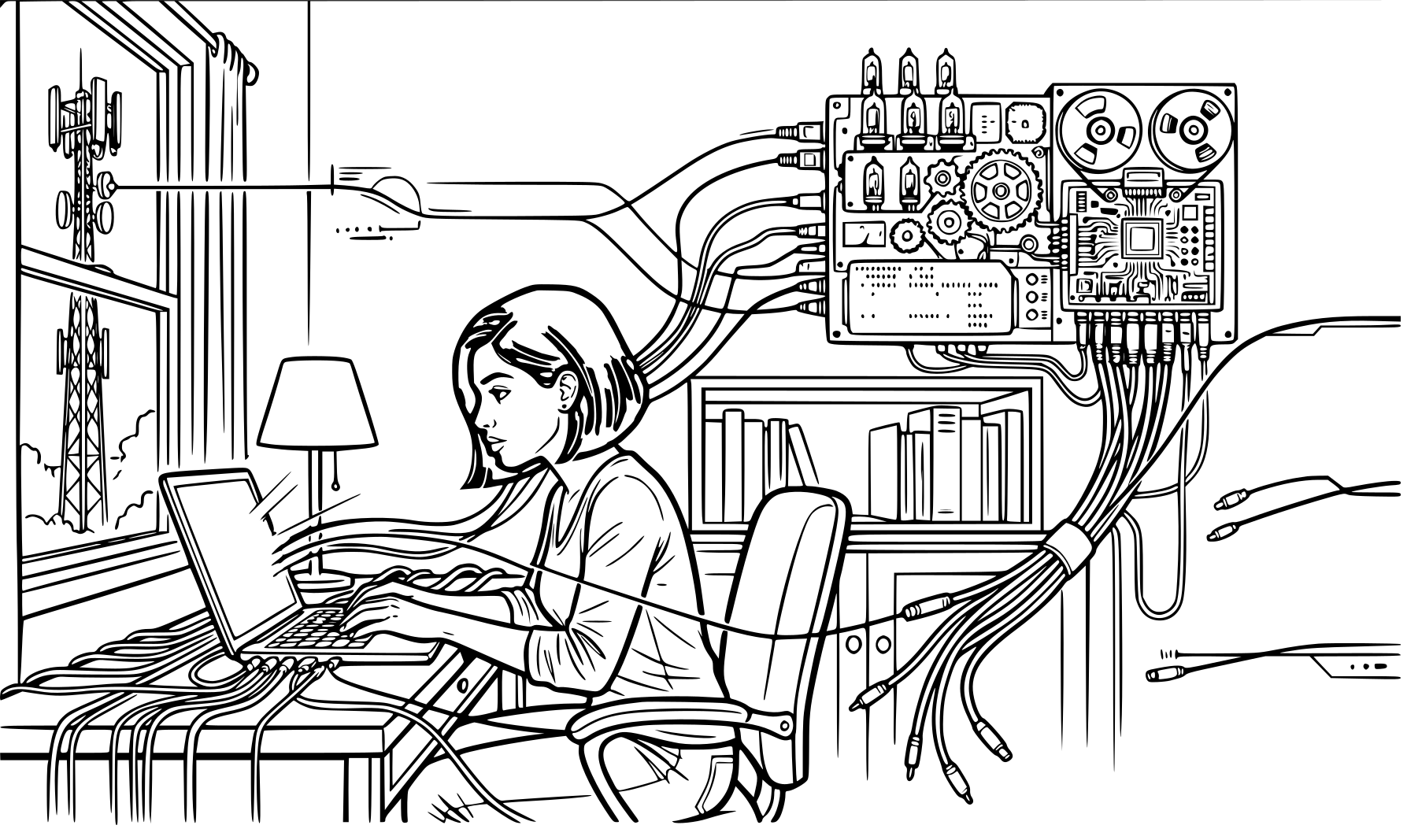
The Phantom of the Flat
Kira treated her digital footprint like someone on the run. She had no social media accounts whatsoever and felt entirely overwhelmed by the endless noise of public online life. She was, in her own estimation, absolute royalty at staying off the grid.
She bought prepaid gift cards with cash for her online purchases, routinely burned her browser cookies, and considered Private Mode to be her magic shield. While her friends slapped their entire lives across the public domain: posting photos of their artisanal sourdough, their newborn babies, and their geographic location down to the exact pub table, Kira walked through the world as a phantom. She had "nothing to hide," of course, but she fundamentally refused to turn her personal life into a product for big tech.
Or so she thought.
The Ghost in the Machine
It started with the ads. Kira was reading an obscure article on the history of 19th-century typewriter keys on a news site she'd never visited before. Up popped a banner for an absurdly niche, highly specific hobbyist group in London.
"The National Rubber Duck Racing Championships & Tuning Guide," the banner proclaimed in bold, blinding letters.
Kira's tea mug froze halfway to her lips. Her heart did a frantic, chaotic tap-dance against her ribs. Competitive rubber duck racing was an extraordinarily bizarre world. In fact, Kira had only ever heard the term used once in her entire life: forty-eight hours ago, over a hilariously chaotic, late-night phone call with her sister, Diya.
Diya had impulsively entered a charity duck race at a village fete near Leeds, raving through the phone speaker about "streamlining rubber beaks for maximum hydrodynamic efficiency." Kira had never searched for toy ducks on her laptop. She hadn't typed "waterproof tuning wax" into a single search engine. She hadn't sent an email, a text message, or an online message about it. She had simply sat on her sofa, listened to her sister giggle over the line, and said, "You're completely mad."
Yet here was the advertisement, staring back at her like a smug, omniscient monster.
"How on earth...?" Kira muttered, her stomach doing a sudden, bewildering somersault.
She instantly opened her settings, frantically purging her browser cache, deleting her history, and nuking her cookies with absolute fury. She felt completely exposed. How? Did tech companies have a microphone hidden inside her floorboards? Was her phone secretly listening to her every breath?
The reality, she was about to discover, was infinitely more bizarre than a simple hidden microphone.
The Unseen Signature
The next morning, Kira marched straight into the office of Dev, the senior network architect at her recruitment firm. Dev was a brilliant, eccentric man whose desk was a graveyard of dismantled hard drives and crushed energy drink cans.
"Dev," she blurted out, slumping into his spare chair. "My laptop is reading my mind. Or my room is bugged. I am not exaggerating."
Dev slowly lowered his mug, a faint, sympathetic smirk tugging at the corner of his mouth. "Ah. You've had your first 'Targeted Revelation' moment, haven't you? What was it? A pair of boots you thought about in the shower?"
"Worse," Kira said, her voice dropping to an anxious whisper. She explained the phone call with Diya, her complete lack of online searches, and the terrifyingly accurate advertisement that appeared out of thin air.
Dev leaned back, interlacing his fingers. "Ah, Kira, you think privacy is a name tag. You think because you don't type your real name into a website or post selfies in front of Big Ben, you're invisible. You're trying to dodge a spotlight by hiding behind a lamp-post."
"I use Private Mode!" she protested defensively. "I delete my cookies every single night!"
"Cookies are only part of the puzzle," Dev explained, gesturing to his screen. "Modern tracking has moved way beyond them. Most systems don't even need them anymore to piece together a clear profile. Every time you move your cursor or load a page, your browser shares a quiet stream of data in the background."
He turned his monitor towards her and brought up a stark, terrifying interface.
"When you visited that news site, you didn't send them a cookie. You sent them your device configuration. Your specific operating system version, screen resolution, graphics card drivers, installed system fonts, battery level, and browser extensions. Combine those, and you get a signature. A Browser Fingerprint. The odds of someone else on Earth having your exact combination of hardware and software variables are literally one in tens of millions."
Kira stared at the screen, her mouth wide-open.
"Then there's your behavioral footprint," Dev continued, his tone leaning in with quiet intensity. "Your location patterns. The exact times you log on. The specific rhythm and millisecond speed of your typing. The agonising, three-second pause you make over specific posts when you read a headline about quirky local hobbies. You don't need to search for 'Duck Tuning'. Your sister searched for it from her house. You then connected to the same residential Wi-Fi network when you visited her last month. Your phone pinged the same mobile mast. Your typing rhythm slowed down when her message popped up on your screen. The algorithm didn't read your mind, Kira. It just connected the absurdly precise breadcrumbs you leave behind every second you exist online."
Scrambling the Signal
Kira hadn't been invisible at all; she had simply been operating in a state of naive complacency. She had believed that hiding her face was the same as controlling her identity. In reality, her daily online routines had assembled an undeniable, living profile of her private world, her real-world relationships, and her deepest personal concerns.
"So I'm completely helpless then?" she asked, a wave of profound defeat washing over her. "It's either live in a cave or be stripped naked by algorithms?"
"Not even close," Dev said, tapping his desk. "Privacy isn't about running away to live in a forest; it's about digital literacy. It's about taking back control of your identity instead of handing the keys over to the highest bidder."
He leaned forward, pointing at his screen. "And make no mistake. Those bidders aren't just trying to sell you rubber ducks. When advertisers buy access to your profile, they aren't just showing you ads; they're actively probing your weak spots. If an algorithm knows you're stress-shopping at 2:00 AM, browsing flight tickets from a high-end laptop, or scanning a supermarket loyalty app, you get served different prices and discounts than the person sitting next to you. Worse still, your daily habits, words, and online behaviour get bundled up into cheap, mass-market datasets used to train predictive AI models without your consent. You aren't just being marketed to; your digital life is being scraped for pennies to make tech algorithms smarter at exploiting you and everyone around you."
Over the next hour, Dev guided Kira through a practical digital overhaul. He didn't tell her to throw her laptop into the River Thames. Instead, he gave her a simple, actionable strategy to blur her digital footprint into a useless cloud of noise.
First, he swapped her standard browser for a privacy-focused alternative paired with strict security settings. This masked her computer's technical details, forcing her device to look identical to millions of others online. Next, they opened her system settings to switch off all diagnostic data, analytics, and background reporting that automatically send daily habits back to tech companies.
Then, he installed a free, community-built tracker blocker: a simple extension designed to stop invisible scripts from monitoring her clicks and scroll habits. Finally, he showed her how to set up separate browser profiles so her personal searches, shopping, and work could never be cross-referenced or linked together.
The Architecture of Control
Walking home that evening through the drizzle of the city, Kira pulled out her smartphone. She looked at the smooth glass screen, no longer seeing a magic window or an invasive spy, but an intricate system of trade-offs.
She hadn't vanished into thin air, nor did she need to. She had stepped out of the fog of passive acceptance and into the driver's seat of her own digital existence. As she glided past the glowing billboards and smart-city sensors lining the high street, she knew the breadcrumb trail would always exist. But Kira was the one deciding exactly where those breadcrumbs would lead.
This story is for educational and illustrative purposes only. It does not constitute professional advice.