TL;DR
Adam thought trading his location data for cheaper car insurance was a sensible transaction. But when a third-party breach exposes his private routes and algorithmic risk models spike his rates anyway, he learns that digitised data is hyper-portable, easily sold, and impossible to recall.
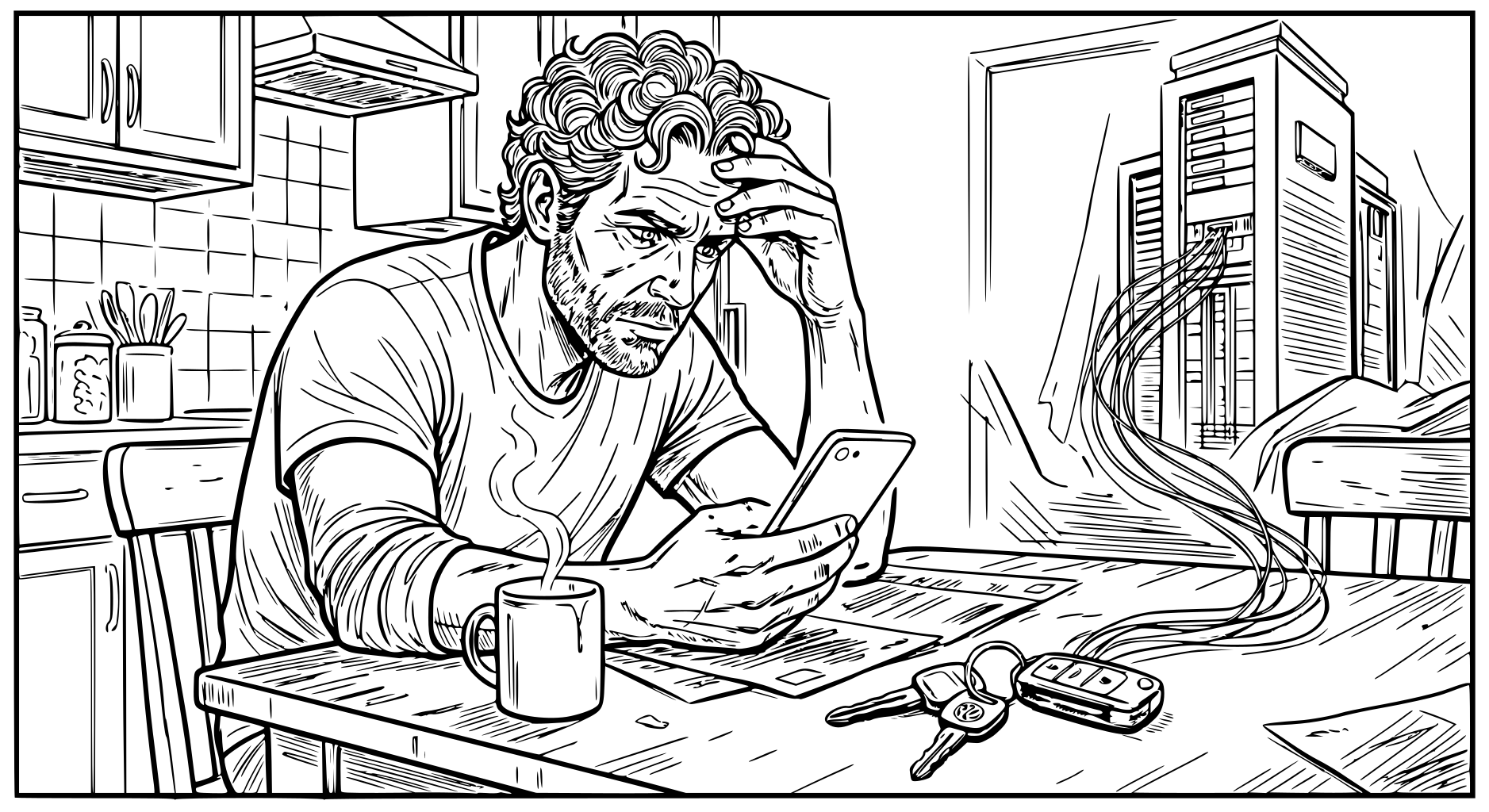
The Price of Frictionless Living
Adam liked to think of himself as a sensible chap. Balancing two kids, the chaotic morning school run, a soul-crushing commute, and late-night delivery shifts meant his entire existence was held together by a prayer, a tight budget, and a meticulously colour-coded calendar that looked like a crime scene investigation board. He didn't have the luxury of paranoias or complicated digital rituals. If an app promised to shave ten minutes off his routine or save twenty pounds a month, he tapped "Agree" without reading the lengthy terms of service.
To Adam, personal data wasn't a sacred secret; it was simple currency. You handed over a bit of background info, and in return, the modern world ran smoothly.
His favourite bargain was his car insurance policy. Six months ago, his provider introduced a smart-savings initiative: install a small telematics app on his mobile phone to monitor his driving habits, and receive an immediate 15% discount. The deal felt entirely transparent. Adam was a saint on the road. He rarely sped, braked smoothly, and kept to predictable routes between the estate, the children's school, and his delivery zones.
For months, the arrangement worked beautifully. The dashboard on his phone awarded him high safety scores, and the monthly premiums dropped as promised. He congratulated himself on outsmarting the rising cost of living.
The Frictionless Leak
Suddenly, an alert popped up on his phone from his primary bank, flagging an unauthorised attempt to apply for a small personal loan in his name. Confused and mildly panicked, he immediately phoned the bank's fraud department. After a tense twenty minutes verifying his identity, the analyst dropped a disturbing piece of context.
"Mr. Smith, your details appear to have been compromised in a recent third-party breach," the representative explained smoothly. "It looks like personal credentials, home address, and precise vehicle location logs were leaked online."
"A breach?" Adam asked, holding the phone tightly to his ear. "My bank account was hacked?"
"Not your bank account," the representative clarified. "The leak originated from an analytics vendor contracted by your motor insurer. The data was scraped from their cloud storage three weeks ago."
Adam sat frozen as the windshield wipers scraped back and forth. He hadn't signed an agreement with an analytics company. He had signed an agreement with his insurance company, a reputable brand with bright, reassuring TV ads.
His entire life—his 8:15 AM school drop-offs, his 11:30 PM takeaway delivery runs, his secret 1:00 AM sessions idling in the driveway eating a family-sized bag of cheese puffs while blasting 80s power ballads—was sitting on a dark-web forum, packaged like a budget bundle and auctioned off for pennies.
He spent the evening scouring news outlets until he found the press release tucked away on a tech journalism site. The insurer had outsourced its driver risk modelling to a third-party data broker. That broker, in turn, stored raw GPS coordinates, trip timestamps, and vehicle registration details on an unsecured server. The low marginal cost of storing and moving digital files meant his location history had been copied, transferred, and processed across multiple systems without his knowledge, until a dark-web forum scraped the lot.
His daily life; his exact departure times, his children's school location, his late-night delivery stops, and his weekend supermarket trips were sitting in a downloadable database.
The Algorithmic Trap
If the data breach was a slap in the face, the letter arriving two days later was a kick in the teeth.
It was his annual insurance renewal notice. Far from dropping further, his premium had spiked by forty percent.
Furious, Adam called customer service, ready to demand an explanation for how a safe driver's rates could skyrocket after their own contractor leaked his data.
The representative spoke with the flat warmth of a pre-recorded message. "The renewal rate reflects a recalibration by our new risk algorithm, Mr. Smith. It's fully automated."
"I have a ninety-eight percent safety score on your app!" Adam argued. "I don't speed. I don't slam on the brakes."
"The algorithm evaluates broader contextual risk variables," the agent replied carefully. "Our updated model factors in late-night transit frequencies and high-density parking patterns. Driving between eleven PM and two AM, even within speed limits, statistically elevates vehicle risk exposure. Furthermore, frequent parking near high-traffic commercial zones impacts your baseline profile."
Adam stared at the wall. The app hadn't just been measuring how safely he drove; it was cataloguing where and when he worked his second job. The very data he'd handed over to save a few quid was now being twisted by some unseen algorithm to bump up his bill. The system took his private life, monetised it behind the scenes through contractors, leaked it to cybercriminals, and then penalised him for the life patterns it revealed.
Taking Back Control
That evening, Adam put the kettle on and decided he was done being a passive customer. Settling for whatever price an algorithm threw at him wasn't just bad for his wallet—it was precisely what allowed these companies to get lazy and exploitative in the first place. If businesses were going to treat his daily life like a free-for-all asset, the least he could do was take his custom elsewhere and force them to actually compete for it.
He started with his phone. He opened his settings and stripped location access from every non-essential app on the device. Goodbye, hyper-targeted local ads; hello, longer battery life. Next, he uninstalled the insurance tracker with a thumb-press so forceful he nearly cracked his screen. He didn't need to throw his phone away or abandon modern tech. He just needed to set some basic boundaries.
When it came to his money, he realised he held far more leverage than he thought. Having an existing car loan or mortgage doesn't lock you into being taken for a ride by your insurer. Existing agreements may be untouchable, but when renewal rolls around, the power shifts back to the consumer.
Adam spent twenty minutes shopping around, securing a standard, fixed-rate policy from a competitor that offered a fair price based on his actual driving record, without demanding round-the-clock surveillance. If more people refused to settle and actually voted with their wallets, companies wouldn't get away with abusing user trust. Switching wasn't just about saving money today—it was about keeping the whole market honest.
Finally, to safeguard against the breach, he took five minutes to place a quick security freeze on his credit profile online. It cost nothing, left his existing bank accounts, direct debits, and current loans running completely as normal, but ensured no stranger holding his leaked data could open a new account in his name.
Adam locked his screen and set the phone on the counter with a quiet smirk. He hadn't wiped himself off the map. He'd simply reminded the market that his business, and his privacy, had to be earned.
This story is for educational and illustrative purposes only. It does not constitute professional advice.