TL;DR
Molly thought her private sketchbooks on an old web portfolio were long forgotten. But when a brand-new generative creation tool spits out artwork bearing her unmistakable, highly specific brushstrokes, she discovers the terrifying reality of digital scraping. Realising her life's work was harvested for profit to power the software undercutting her livelihood, she learns to fight back and reclaim her creative domain.
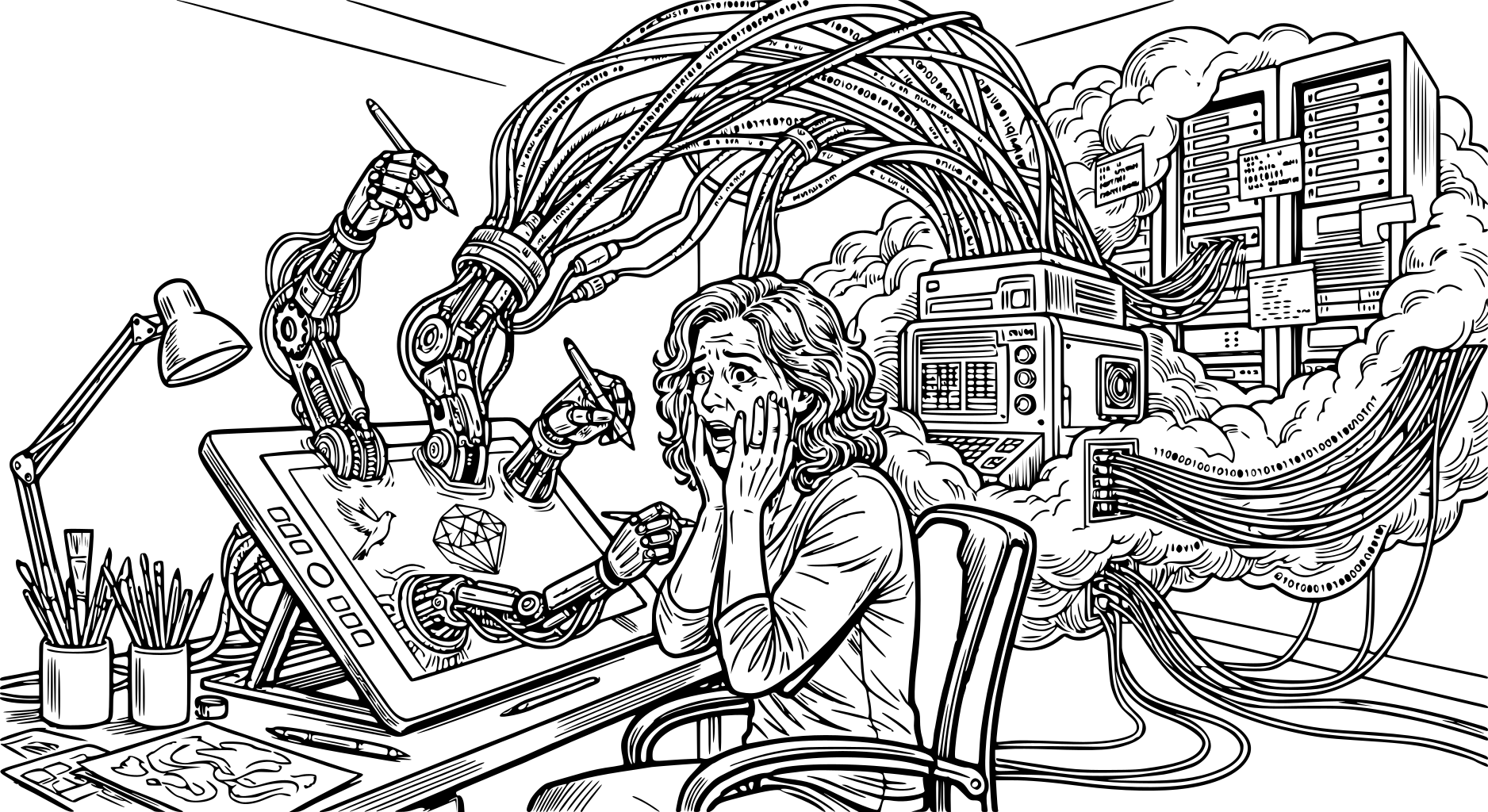
The Sacred Canvas
Art was how Molly spoke to the world when standard conversation didn't feel like enough. She had spent over a decade quietly shaping a visual style that was entirely her own. Over the years, her work hit a stride that was instantly recognisable: absurdly dramatic, beautifully painted scenes revealing a secret midnight workforce of badgers and foxes clocking into their night shifts, quietly rolling up their sleeves to tackle the everyday human catastrophes of overturned wheelie bins, crushed drink cans, and abandoned shopping trolleys. Digital drawing was her way of bringing joy to people and finding where she belonged. Her portfolio was built over years of quiet nights, endless focus, and mugs of herbal tea left cold and forgotten beside her tablet.
To survive in the cut-throat world of modern design, she had recently taken on remote work configuring prompt inputs for clients. It wasn't her true passion, but it paid the bills while keeping her fingers nimble. She accepted that the world was moving at a dangerously fast pace. She accepted that automation was sweeping through every corner of human existence like a raging, unstoppable tsunami.
What she never, ever expected was to find her own heart ripped out and served back to her on a glowing silver platter.
The Monster in the Mirror
It happened on a quiet Tuesday evening while testing a hyper-hyped, newly released generative visual creator. The program promised to transform simple written ideas into mind-boggling, museum-grade masterpieces in a matter of milliseconds.
Curious, Molly typed in a quirky, imaginative idea she'd sketch on a rainy afternoon: A badger in a high-vis jacket staring in complete despair into an overturned wheelie bin.
She hit enter. The screen flickered for a fraction of a second, and then the software unleashed an image that instantly caused every drop of blood in her veins to freeze solid.
Her jaw dropped in absolute horror. Her heart hammered against her ribs like an imprisoned bird.
The image wasn't just similar to her style. It was her style. There was her signature, hyper-specific cross-hatching pattern. There was the exact, unconventional emerald-and-violet gradient she had invented three years ago for an obscure art exhibition. There was even a subtle, tragic flaw in the lighting rendering that she had made on a late-night project in 2021—a tiny, distinctive mistake that no other human being on planet Earth could have ever replicated.
"No..." she gasped, her voice trembling as she leaned close enough to touch the glass. "This is impossible. How is this possible?!"
Panicking, she typed in another prompt, adding her own name to the text box. The application instantly spat out a dozen jaw-dropping, stunning illustrations that looked as if she had spent six agonising months slaving over her drawing tablet.
Her life's work had been utterly devoured. The unique visual language she had spent her whole life building had been stolen, dismantled, liquefied, and poured into a digital blender to create an infinite, instantaneous clone machine.
The Machine's Appetite
Driven by a furious, burning desperation, Molly spent the next forty-eight hours hunting through the dark, murky underbelly of the web. She tracked down the technical white papers published by the massive tech company behind the software.
What she uncovered was a staggering, industrial-scale operation of stolen art.
In reality, relentless, automated web-crawling spiders had swept across every square inch of the internet day and night, vacuuming up billions of private images, personal blogs, family photos, and hard-earned digital assets without a single shred of human consent.
These tech giants had treated every scrap of human creativity on the internet as free, bottomless fuel for their massive software engines. Invisible tracking pixels, automated scrapers, and low-paid digital workers had painstakingly tagged her brushstrokes, dissecting her private passion down to the most precise mathematical coordinates.
They didn't just borrow her style; they consumed it entirely. They took her soul for free, transformed it into a commercial product, and were now selling access to her own identity back to the market for a monthly subscription fee, rendering her professional freelancing totally obsolete in the process.
Taking Back Control
Once the initial shock wore off, Molly realised that begging the tech giants to stop was pure comedy. Sure, platforms offered shiny "opt-out" forms and robot-blocking tags, but that was mostly smoke and mirrors. A polite gesture while the scrapers carried on under new names anyway.
So, Molly changed tack entirely. Instead of fighting the flood, she went completely counter-cultural.
She stripped her site of pristine digital files, replacing them with tiny, compressed previews—plenty clear for a human, but useless grain to a scraper. The actual high-res originals were locked away, delivered directly to paying clients via secure, private links.
More importantly, she brought her digital creations into the physical world. In a world drowning in infinite instant images, she realised she wasn't the only one feeling exhausted. Most people simply don't have the time to wade through endless pages of generated filler, nor do they want to spend their evening wrestling with text prompts for something they can't quite picture on a mug. When abundance is everywhere, people crave thoughtful, finished decisions.
She also came to realise that anyone content with a quick, generated output was after a totally different experience anyway. People who care about art aren't looking for a shortcut. They're looking for connection, human perspective, and the story behind the craft.
Instead, she started turning her badger-and-fox night-shift art into heavy, gold-embossed prints, textured enamel pins, and gorgeous tactile notebooks. High-quality physical goods a prompt box couldn't magically churn out on a desk.
By making her work material and staying stubbornly niche, she didn't just dodge the bots; she made her craft irreplaceable. The machine could go on eating its own tail. Molly had already moved on to bigger, better, and much more fun things.
This story is for educational and illustrative purposes only. It does not constitute professional advice.