TL;DR
Personal trainer Luke discovered that his clean protein shakes were more like processed gunk than fuel. By moving his clients from powders to bioavailable, whole-food sources, they unlocked real gains. They traded brain fog and bloating for sustained energy, proving that true strength starts with what your body can actually absorb.
The Muscle Man
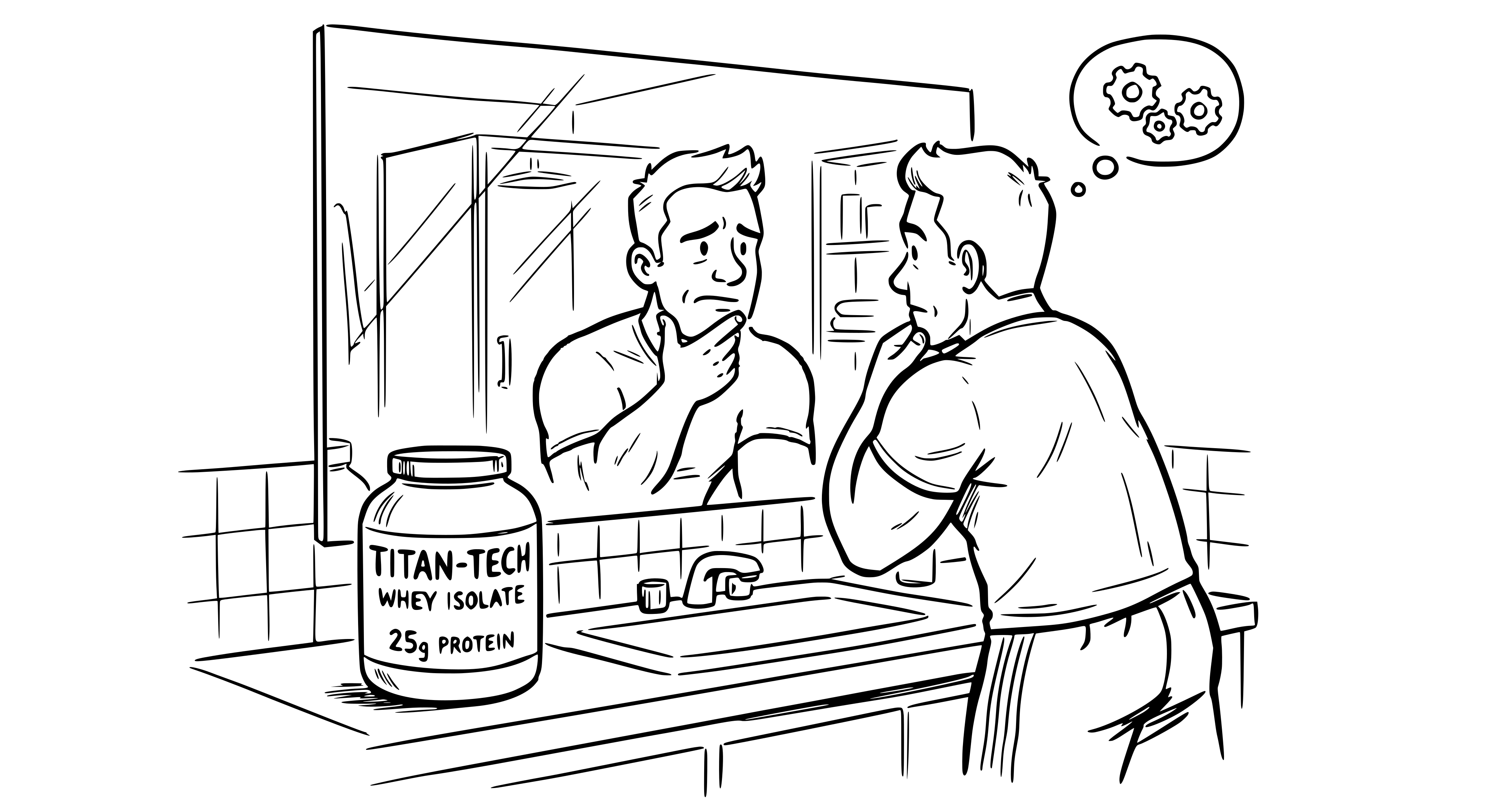
Luke stood in front of the mirror, flexing his left bicep. To anyone else, he looked like he'd been carved out of solid oak, but to Luke, he was a structural work-in-progress with a slightly dodgy exterior. As a personal trainer, his physique was his shop window, and he kept that window polished with a single, unwavering rule: two grams of protein for every kilo of body weight.
Protein was his holy grail. He knew it was the primary building block of life, essential for repairing the microscopic tears in his muscle fibres and keeping his enzymes and immune system from crashing. But hitting those numbers while running back-to-back gym sessions was a logistical nightmare. To bridge the gap, Luke lived off a shimmering silver tub of "Titan-Tech Whey Isolate" that promised "Industrial-Strength Bioavailability."
He survived on three shakes a day. One scoop of the ultra-fine powder, a quick rattle in a plastic bottle, and a chalky, vanilla-scented gulp. It was efficient. It was concentrated. It was also £70 a month, which Luke considered a muscle tax he was happy to pay.
A Dodgy Deal
The first sign that something was off didn't happen in the squat rack; it happened in his bathroom mirror. Despite his clean diet, Luke was breaking out like a teenager before prom. His skin was angry, and he felt a persistent, low-level bloating that made his six-pack feel more like a keg. To be honest, he was making noises when he sat down that belonged to a man twice his age.
"Maybe it's the pre-workout?" he muttered, reaching for his silver tub.
He wasn't the only one. His star client, Maddie, was hitting her protein targets perfectly but felt like she was wading through treacle during her morning runs. Then there was Tom, a student who'd gone full vegan but was struggling with brain fog so thick he'd recently tried to unlock his front door with a cereal bar.
The VIP Guest List
One afternoon, Luke found himself squinting at the back of his "Titan-Tech" tub. He'd always focused on the "25g Protein" headline, but now he was reading the small print. Underneath the bold claims were words he couldn't pronounce: Acesulfame Potassium, Xanthan Gum, Silicon Dioxide. He realised his clean protein had more in common with a pot of gloss paint than a steak. To make that powder taste like a melted milkshake and stay shelf-stable for longer than a preserved pharaoh, the manufacturers had packed it with processed gunk.
"The problem," Luke explained to Maddie later that day, gesturing at the label, "isn't just the protein. It's the bioavailability."
"Bio-what?" Maddie asked, mid-burpee.
"Bioavailability. Think of your body like a high-end club with a very picky bouncer," Luke said. "Just because you shove 30 grams of protein into your mouth doesn't mean 30 grams gets through the door. If the protein is wrapped up in synthetic gums and artificial sweeteners, your 'gut-bouncers' get confused. They spend all their energy fighting the chemicals and trying to work out if 'Acesulfame' is a real person, while the actual nutrients get tossed out the back door into the alleyway. High bioavailability means the bouncer recognises the guest and lets them straight into the VIP lounge (your muscles)."
Ferrari on a Budget
Luke decided to run an experiment. He staged a low-key intervention at the gym's juice bar. "We're overcomplicating the engine," he told his squad. "We're effectively trying to run a Ferrari on sunflower oil."
He challenged them to a "Whole-Source Fortnight." No silver tubs. No synthetic bars that tasted like sweetened insulation.
For Tom, the vegan, he ditched the soy-isolates that were giving him the digestive grace of a steam engine. Luke showed him how to mix hemp and pea protein—raw, unflavoured powders that didn't need a lab to exist. "It tastes a bit like a hedge," Tom admitted, "but at least I can remember where I parked my bike now."
For Maddie, she focused on the gold standard. Instead of high-speed whey that hit her system like a 5 AM alarm clock and left her crashed an hour later, she moved to free-range eggs and sardines. "The cost per usable gram is actually cheaper," Luke explained, "because your body isn't wasting energy fighting the hidden extras on the ingredients list. Plus, sardines are basically nature's multi-vitamin in a tin."
The Cheat Sheet
Ten days in, the gym felt different. The brain fog Tom had been struggling with cleared up. His microbiome was finally getting a break from the artificial sweeteners. Maddie's energy levels stabilised; she wasn't just hitting her macros, she was actually absorbing them.
Luke's own skin cleared up, and the keg feeling in his gut vanished. He realised he didn't need to be an "Industrial Athlete" to be strong. He just needed to stop seasoning his muscles with industrial waste.
He didn't throw away the silver tub. It cost seventy quid, after all. But he moved it to the back of the cupboard for emergencies only, right next to a tin of spam from five years ago. He started teaching his clients that a body built on real, bioavailable protein wasn't just about looking good in a selfie; it was about building a foundation that was actually solid. His new "business card" wasn't just his biceps; it was the fact that he could finally finish a session without his stomach sounding like a bag of angry cats.
This story is for educational and illustrative purposes only. It does not constitute professional advice.